
Ch. 3 The Cellular Level of Organization
Martini - Fundamentals of Anatomy & Physiology 11th Edition
Martini, Nath, Bartholomew11th EditionFundamentals of Anatomy & PhysiologyISBN: 9780136874089Not the one you use?Change textbook
Chapter 3, Problem 15

List five important factors that influence diffusion rates.

Verified step by step guidance
1
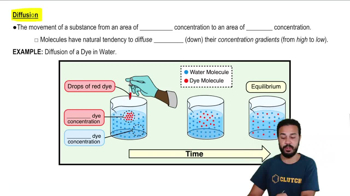
Understand that diffusion is the movement of molecules from an area of higher concentration to an area of lower concentration, and the rate at which this occurs depends on several factors.
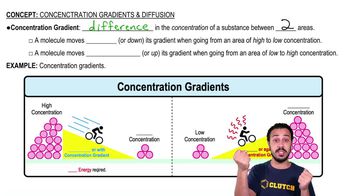
Identify the first factor: the concentration gradient. A steeper concentration gradient increases the diffusion rate because molecules move more rapidly from high to low concentration.
Consider the second factor: the temperature. Higher temperatures increase molecular kinetic energy, which speeds up diffusion.
Recognize the third factor: the surface area available for diffusion. A larger surface area allows more molecules to diffuse at once, increasing the rate.
Note the fourth and fifth factors: the size of the diffusing molecules (smaller molecules diffuse faster) and the permeability or thickness of the membrane (thinner or more permeable membranes allow faster diffusion).

Verified video answer for a similar problem:

This video solution was recommended by our tutors as helpful for the problem above.
Video duration:
3m
Was this helpful?

Key Concepts

Here are the essential concepts you must grasp in order to answer the question correctly.

Diffusion Process

Diffusion is the movement of particles from an area of higher concentration to lower concentration. Understanding this process is essential to grasp how various factors can speed up or slow down the rate at which substances spread.
Recommended video:
02:44
Diffusion

Concentration Gradient

The concentration gradient is the difference in concentration between two regions. A steeper gradient increases the diffusion rate because particles move more rapidly to balance concentrations.
Recommended video:
04:51
Concentration Gradients and Diffusion

Temperature Effects

Temperature influences diffusion by affecting particle energy; higher temperatures increase particle movement, leading to faster diffusion rates, while lower temperatures slow down the process.
Recommended video:
1:32
Effects of the Complement System