Ch. 29 Development and Inheritance
Martini - Fundamentals of Anatomy & Physiology 11th Edition
Martini, Nath, Bartholomew11th EditionFundamentals of Anatomy & PhysiologyISBN: 9780136874089Not the one you use?Change textbook
Chapter 28, Problem 24c

Indicate the type of inheritance involved in each of the following situations. 
(c) The trait is expressed more commonly in sons than in daughters. 

Verified step by step guidance
1
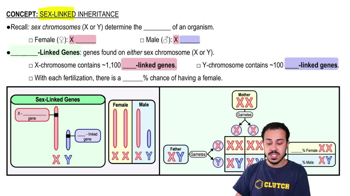
Understand the concept of inheritance patterns: Traits can be inherited through autosomal or sex-linked inheritance. Sex-linked inheritance involves genes located on sex chromosomes (X or Y).
Recognize that traits expressed more commonly in sons than in daughters often suggest X-linked inheritance. This is because males have only one X chromosome, so a recessive allele on the X chromosome will be expressed in males.
Recall that females have two X chromosomes, so they would need two copies of the recessive allele for the trait to be expressed. This makes the trait less common in daughters.
Consider examples of X-linked traits, such as hemophilia or color blindness, which are more frequently observed in males due to the inheritance pattern.
Conclude that the type of inheritance involved in this situation is likely X-linked recessive inheritance, based on the description of the trait being more common in sons than daughters.

Verified video answer for a similar problem:

This video solution was recommended by our tutors as helpful for the problem above.
Was this helpful?

Key Concepts

Here are the essential concepts you must grasp in order to answer the question correctly.

Sex-Linked Inheritance

Sex-linked inheritance refers to traits that are associated with genes located on sex chromosomes, particularly the X and Y chromosomes. In many cases, traits linked to the X chromosome are expressed differently in males and females due to the presence of only one X chromosome in males (XY) compared to two in females (XX). This can lead to certain traits being more commonly expressed in males, especially if the trait is recessive.
Recommended video:
04:17
Sex-Linked Inheritance

Autosomal vs. Sex-Linked Traits

Autosomal traits are those determined by genes located on non-sex chromosomes (autosomes), while sex-linked traits are influenced by genes on sex chromosomes. Understanding the distinction is crucial for determining inheritance patterns. If a trait is expressed more in sons than daughters, it often indicates a sex-linked inheritance pattern, particularly if the trait is recessive and located on the X chromosome.
Recommended video:
04:17
Sex-Linked Inheritance

Recessive and Dominant Alleles

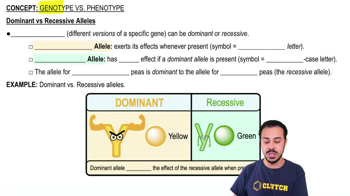
Alleles can be classified as dominant or recessive based on their expression in the phenotype. A dominant allele will mask the effect of a recessive allele in a heterozygous individual. In the context of sex-linked traits, if a recessive allele is present on the X chromosome, it may be expressed in males who have only one X chromosome, leading to a higher prevalence of the trait in sons compared to daughters.
Recommended video:
03:39
Dominant vs. Recessive Alleles