
Textbook Question
What interacting controls stabilize the glomerular filtration rate (GFR)?
1
views

 Verified step by step guidance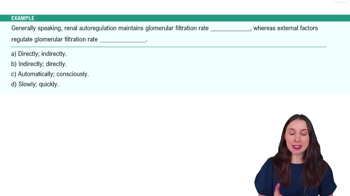
 1:11
1:11
 05:03
05:03 1:00
1:00What interacting controls stabilize the glomerular filtration rate (GFR)?
What primary changes occur in the composition and concentration of filtrate as a result of activity in the proximal convoluted tubule?
How are proteins excluded from filtrate? Why is this important?
Sympathetic activation of nerve fibers in the nephron causes
(a) the regulation of glomerular blood flow and pressure,
(b) the stimulation of renin release from the juxtaglomerular complex,
(c) the direct stimulation of water and Na+ reabsorption,
(d) all of these.
When ADH levels rise,
(a) The amount of water reabsorbed increases.
(b) The DCT becomes impermeable to water.
(c) The amount of water reabsorbed decreases.
(d) Sodium ions are exchanged for potassium ions.
Sodium reabsorption in the DCT and in the cortical portion of the collecting system is accelerated by the secretion of
(a) ADH
(b) Renin
(c) Aldosterone
(d) Erythropoietin