

Ch. 26 The Urinary System
Martini - Fundamentals of Anatomy & Physiology 11th Edition
Martini, Nath, Bartholomew11th EditionFundamentals of Anatomy & PhysiologyISBN: 9780136874089Not the one you use?Change textbook
Chapter 25, Problem 28

Sylvia is suffering from severe edema in her arms and legs. Her physician prescribes a diuretic (a substance that increases the volume of urine produced). Why might this help alleviate Sylvia’s problem?

Verified step by step guidance
1
Understand that edema is the accumulation of excess fluid in the interstitial spaces of tissues, causing swelling, especially in extremities like arms and legs.
Recognize that the volume of fluid in the body is regulated by the balance between fluid intake, fluid loss, and the movement of fluid between blood vessels and tissues.
Know that diuretics increase urine production by the kidneys, which leads to increased excretion of water and electrolytes from the body.
Realize that by increasing urine output, diuretics reduce the overall fluid volume in the bloodstream, which decreases the hydrostatic pressure in blood vessels.
With lower hydrostatic pressure, less fluid leaks out of the blood vessels into the interstitial spaces, thereby reducing edema and alleviating Sylvia's swelling.

Verified video answer for a similar problem:

This video solution was recommended by our tutors as helpful for the problem above.
Was this helpful?

Key Concepts

Here are the essential concepts you must grasp in order to answer the question correctly.

Edema

Edema is the abnormal accumulation of fluid in the tissues, causing swelling, often in the arms and legs. It results from an imbalance between fluid filtration and reabsorption in blood vessels and lymphatic drainage. Understanding edema helps explain why reducing fluid volume can relieve swelling.
Recommended video:
3:15
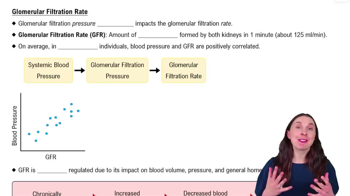
Glomerular Filtration Rate

Diuretics

Diuretics are medications that increase urine production by the kidneys, promoting the excretion of excess water and salts. This reduces the overall fluid volume in the body, which can help decrease swelling caused by fluid retention, such as in edema.
Recommended video:
0:48
Renal Physiology Step 2: Tubular Reabsorption Example 5

Fluid Balance and Homeostasis

The body maintains fluid balance through mechanisms controlling intake, distribution, and excretion of water and electrolytes. Disruptions can lead to fluid buildup in tissues. Diuretics assist in restoring homeostasis by removing excess fluid, thereby alleviating symptoms like edema.
Recommended video:
Guided course
01:59
Introduction to Homeostasis
Related Practice
Textbook Question

In a normal kidney, which of the following conditions would cause an increase in the glomerular filtration rate (GFR)? 

(a) Constriction of the afferent arteriole

(b) A decrease in the pressure of the glomerulus

(c) An increase in the capsular hydrostatic pressure

(d) A decrease in the concentration of plasma proteins in the blood

(e) A decrease in the net glomerular filtration process

1
views
Textbook Question

The drug Diamox is sometimes used to treat mountain sickness. Diamox inhibits the action of carbonic anhydrase in the proximal convoluted tubule. Polyuria (excessive urine production resulting in frequent urination) is a side effect associated with the medication. Why does polyuria occur?

1
views
Textbook Question

Describe the urine voiding reflex.

Textbook Question

Mannitol is a sugar that is filtered, but not reabsorbed, by the kidneys. What effect would drinking a solution of mannitol have on the volume of urine produced?

2
views
Textbook Question

David’s grandfather suffers from hypertension. His doctor tells him that part of his problem stems from renal arteriosclerosis. Why would this cause hypertension?

1
views
Textbook Question

In response to excess water in the body, 

(a) Antidiuretic hormone is secreted by the anterior lobe of the pituitary gland.

(b) The active transport mechanisms in the ascending thick limb of the nephron loop cease functioning.

(c) The permeability of the distal convoluted tubules and collecting ducts to water is decreased.

(d) The permeability of the ascending limb of the nephron loop is increased.

(e) The glomerular filtration rate is reduced.

1
views