Ch. 21 Blood Vessels and Circulation
Martini - Fundamentals of Anatomy & Physiology 11th Edition
Martini, Nath, Bartholomew11th EditionFundamentals of Anatomy & PhysiologyISBN: 9780136874089Not the one you use?Change textbook
Chapter 21, Problem 20

Which of the following conditions would have the greatest effect on peripheral resistance?
(a) Doubling the length of a vessel
(b) Doubling the diameter of a vessel
(c) Doubling the viscosity of the blood
(d) Doubling the turbulence of the blood
(e) Doubling the number of white cells in the blood

Verified step by step guidance
1
Understand that peripheral resistance in blood vessels is primarily influenced by vessel length, vessel diameter (radius), blood viscosity, and blood flow characteristics such as turbulence.
Recall the formula for resistance in a blood vessel based on Poiseuille's law: \(R = \frac{8 \eta L}{\pi r^{4}}\), where \(R\) is resistance, \(\eta\) is blood viscosity, \(L\) is vessel length, and \(r\) is the radius of the vessel.
Analyze how each condition affects the variables in the formula: (a) Doubling length \(L\) will double resistance linearly; (b) Doubling diameter means doubling radius \(r\), which affects resistance to the fourth power, so resistance changes by a factor of \(2^{4} = 16\); (c) Doubling viscosity \(\eta\) doubles resistance linearly; (d) Doubling turbulence increases resistance but is not directly in Poiseuille's formula and generally has a less predictable effect; (e) Doubling white blood cells has minimal effect on viscosity or flow properties.
Compare the magnitude of changes: since resistance is inversely proportional to the fourth power of radius, changes in diameter have a much greater effect than changes in length or viscosity, which are linear.
Conclude that doubling the diameter of a vessel (option b) would have the greatest effect on peripheral resistance due to the exponential relationship between radius and resistance.

Verified video answer for a similar problem:

This video solution was recommended by our tutors as helpful for the problem above.
Was this helpful?

Key Concepts

Here are the essential concepts you must grasp in order to answer the question correctly.

Peripheral Resistance

Peripheral resistance refers to the resistance to blood flow offered by the blood vessels, primarily the arterioles. It is influenced by factors such as vessel diameter, length, blood viscosity, and flow characteristics. Understanding peripheral resistance is essential to grasp how changes in these factors affect blood pressure and circulation.
Recommended video:
3:33
Peripheral Nervous System

Effect of Vessel Diameter on Resistance

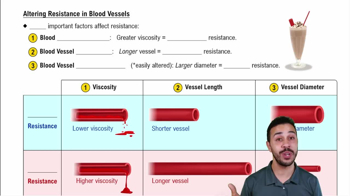
Vessel diameter has a powerful inverse effect on resistance; according to Poiseuille’s law, resistance is proportional to the fourth power of the radius. This means even small changes in diameter cause large changes in resistance, making diameter the most significant factor in controlling blood flow.
Recommended video:
8:32
Altering Resistance in Blood Vessels

Blood Viscosity and Turbulence

Blood viscosity is the thickness of blood, affecting how easily it flows through vessels; higher viscosity increases resistance. Turbulence refers to chaotic blood flow, which also raises resistance by disrupting smooth laminar flow. Both factors influence peripheral resistance but generally less dramatically than vessel diameter.
Recommended video:
6:11
Functions of Blood