
Textbook Question
Net hydrostatic pressure forces water ____ a capillary; net osmotic pressure reabsorbs water _____ a capillary.
(a) into, out of
(b) out of, into
(c) out of, out of
(d) into, into
2
views

 Verified step by step guidance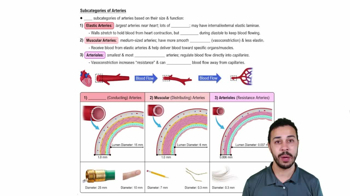
 14:43
14:43 14:43 14:43
Net hydrostatic pressure forces water ____ a capillary; net osmotic pressure reabsorbs water _____ a capillary.
(a) into, out of
(b) out of, into
(c) out of, out of
(d) into, into
The vein that drains the dural sinuses of the brain is the
(a) Cephalic vein
(b) Great saphenous vein
(c) Internal jugular vein
(d) Superior vena cava
The two arteries formed by the division of the brachiocephalic trunk are the:
(a) Aorta and internal carotid
(b) Axillary and brachial
(c) External and internal carotid
(d) Common carotid and subclavian
The vein that collects most of the venous blood inferior to the diaphragm is the
(a) Superior vena cava
(b) Great saphenous vein
(c) Inferior vena cava
(d) Azygos vein
The unpaired arteries supplying blood to the visceral organs include:
(a) The adrenal, renal, and lumbar arteries
(b) The iliac, gonadal, and femoral arteries
(c) The celiac and superior and inferior mesenteric arteries
(d) All of these
What are the primary forces that cause fluid to move?
(a) Out of a capillary at its arterial end and into the interstitial fluid
(b) Into a capillary at its venous end from the interstitial fluid?