Ch. 12 Nervous Tissue
Martini - Fundamentals of Anatomy & Physiology 11th Edition
Martini, Nath, Bartholomew11th EditionFundamentals of Anatomy & PhysiologyISBN: 9780136874089Not the one you use?Change textbook
Chapter 12, Problem 9c

What are the major components of
(c) the enteric nervous system?

Verified step by step guidance
1
Understand that the enteric nervous system (ENS) is a complex network of neurons that governs the function of the gastrointestinal (GI) tract independently of the central nervous system.
Identify the two major plexuses (networks of neurons) that make up the ENS: the myenteric plexus and the submucosal plexus.
The myenteric plexus (also called Auerbach's plexus) is located between the longitudinal and circular layers of the muscularis externa and primarily controls GI motility.
The submucosal plexus (also called Meissner's plexus) is found in the submucosa and mainly regulates enzyme secretion, blood flow, and absorption in the GI tract.
Recognize that these plexuses contain sensory neurons, interneurons, and motor neurons, which together coordinate reflexes and local control of digestion.

Verified video answer for a similar problem:

This video solution was recommended by our tutors as helpful for the problem above.
Was this helpful?

Key Concepts

Here are the essential concepts you must grasp in order to answer the question correctly.

Structure of the Enteric Nervous System

The enteric nervous system (ENS) is a complex network of neurons located in the walls of the gastrointestinal tract. It consists mainly of two major plexuses: the myenteric (Auerbach's) plexus, which controls gut motility, and the submucosal (Meissner's) plexus, which regulates secretion and blood flow.
Recommended video:
2:37
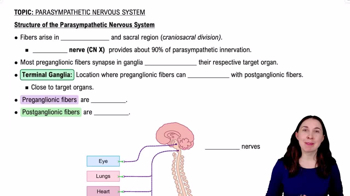
Structure of the Parasympathetic Nervous System

Functions of the Enteric Nervous System

The ENS autonomously manages digestive processes such as peristalsis, enzyme secretion, and blood flow regulation. It operates independently but also communicates with the central nervous system to coordinate overall gut function and respond to physiological changes.
Recommended video:
2:52
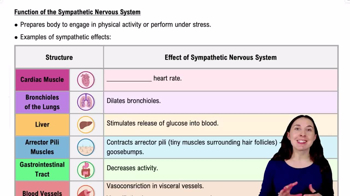
Function of the Sympathetic Nervous System

Neuronal Types in the Enteric Nervous System

The ENS contains various types of neurons including sensory neurons that detect chemical and mechanical changes, interneurons that process information, and motor neurons that control muscle contraction and gland secretion. These diverse neurons enable the ENS to regulate complex digestive activities.
Recommended video:
3:33
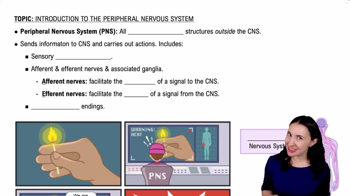
Peripheral Nervous System