Why is it difficult to lift a heavy object when the elbow is at full extension?
Ch. 11 The Muscular System
Martini, Nath, Bartholomew11th EditionFundamentals of Anatomy & PhysiologyISBN: 9780136874089Not the one you use?Change textbook
Chapter 11, Problem 24
The muscles of the vertebral column include many posterior extensors but few anterior flexors. Why?
Verified step by step guidance1
Step 1: Understand the anatomical positioning of the vertebral column muscles. The posterior muscles are located behind the vertebral column, while the anterior muscles are located in front of it.
Step 2: Recognize the functional roles of these muscles. Posterior muscles primarily act as extensors, meaning they straighten or extend the spine, while anterior muscles act as flexors, bending the spine forward.
Step 3: Consider the mechanical advantage and leverage. Posterior extensors have longer lever arms and more muscle mass, allowing them to generate greater force to maintain posture and resist gravity.
Step 4: Note the structural constraints on anterior flexors. The anterior side of the vertebral column has less space due to the presence of organs and other structures, limiting the size and number of flexor muscles.
Step 5: Conclude that the predominance of posterior extensors over anterior flexors is due to the need for strong, sustained extension to maintain upright posture and the anatomical limitations on the anterior side.

Verified video answer for a similar problem:
This video solution was recommended by our tutors as helpful for the problem above.
Was this helpful?
Key Concepts
Here are the essential concepts you must grasp in order to answer the question correctly.
Anatomy of Vertebral Column Muscles
The vertebral column muscles are divided into posterior extensors and anterior flexors. Posterior muscles, such as the erector spinae group, are numerous and strong to maintain posture and extend the spine. In contrast, anterior flexors like the abdominal muscles are fewer and primarily assist in flexion and stabilization.
Recommended video:
Guided course
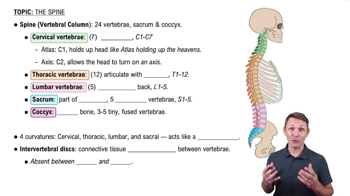
Spine (Vertebral Column)
Functional Role of Extensors vs. Flexors
Extensor muscles of the back are essential for maintaining an upright posture against gravity, requiring greater strength and number. Flexor muscles, located anteriorly, mainly facilitate bending forward and support abdominal pressure, so they are fewer but work in coordination with other muscles for trunk movement.
Recommended video:
Flexor & Crossed-Extensor Reflexes
Biomechanics and Postural Support
The vertebral column's biomechanics demand strong posterior extensors to counterbalance the body's forward weight and prevent collapse. Anterior flexors are less numerous because flexion is less frequent and supported by other muscle groups, ensuring stability and efficient movement without excessive muscle bulk in front.
Recommended video:
Support Structures
Related Practice
Textbook Question
2
views
Textbook Question
Compartment syndrome can result from all of the following except
(a) Compressing a nerve in the wrist
(b) Compartments swelling with blood due to an injury involving blood vessels
(c) Torn ligaments in a given compartment
(d) Pulled tendons in the muscles of a given compartment
(e) Torn muscles in a particular compartment
4
views
Textbook Question
Why does a convergent muscle exhibit more versatility when contracting than does a parallel muscle?
1
views
Textbook Question
Why can a pennate muscle generate more tension than can a parallel muscle of the same size?
2
views
Textbook Question
Elongated bursae that reduce friction and surround the tendons that cross the posterior and anterior surfaces of the wrist form___.
1
views
Textbook Question
A(n)____develops when an organ protrudes through an abnormal opening.
1
views