Ch. 11 The Muscular System
Martini - Fundamentals of Anatomy & Physiology 11th Edition
Martini, Nath, Bartholomew11th EditionFundamentals of Anatomy & PhysiologyISBN: 9780136874089Not the one you use?Change textbook
Chapter 11, Problem 4

Levers make action more versatile by all of the following, except
(a) Changing the location of the muscle's insertion
(b) Changing the speed of movement produced by an applied force
(c) Changing the distance of movement produced by an applied force
(d) Changing the strength of an applied force
(e) Changing the direction of an applied force

Verified step by step guidance
1
Understand the role of levers in the musculoskeletal system: Levers help muscles move bones by providing mechanical advantages, which can affect force, speed, distance, and direction of movement.
Review each option to see if it aligns with how levers function: Levers can change the speed and distance of movement by altering the ratio of effort arm to resistance arm.
Consider the insertion point of a muscle: The location of a muscle's insertion is determined by anatomy and does not change due to lever action; levers work with existing insertion points.
Recall that levers can change the strength (force) applied by muscles by providing mechanical advantage, and they can also change the direction of the applied force depending on the lever class.
Conclude that the exception is the option stating that levers change the location of the muscle's insertion, as this is not a function of levers but rather fixed anatomical structure.

Verified video answer for a similar problem:

This video solution was recommended by our tutors as helpful for the problem above.
Video duration:
3m
Was this helpful?

Key Concepts

Here are the essential concepts you must grasp in order to answer the question correctly.

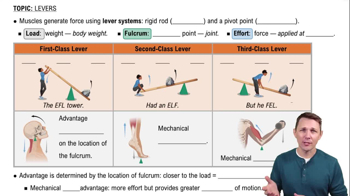
Mechanical Advantage of Levers

Mechanical advantage refers to how levers amplify an input force to produce a greater output force. This concept explains how levers can increase strength, allowing a smaller force to move a heavier load by altering the relative lengths of the effort and load arms.
Recommended video:
Guided course
3:33
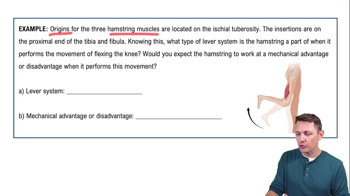
Levers Example 1

Lever Classes and Muscle Insertion

Levers are classified based on the relative positions of the fulcrum, effort, and load. Muscle insertion points affect lever function by determining the force and movement produced, but levers themselves do not change where muscles insert on bones.
Recommended video:
Guided course
3:33
Levers Example 1

Force Direction and Movement Speed in Levers

Levers can change the direction of an applied force and influence the speed and distance of movement. For example, a lever can convert a downward force into an upward movement or increase the speed of the output relative to the input.
Recommended video:
Guided course
8:14
Lever Systems