Ch. 10 Muscle Tissue
Martini - Fundamentals of Anatomy & Physiology 11th Edition
Martini, Nath, Bartholomew11th EditionFundamentals of Anatomy & PhysiologyISBN: 9780136874089Not the one you use?Change textbook
Chapter 10, Problem 8

An action potential can travel quickly from one cardiac muscle cell to another because of the presence of
(a) Gap junctions
(b) Tight junctions
(c) Intercalated discs
(d) Both a and c

Verified step by step guidance
1
Step 1: Understand the structure of cardiac muscle cells and how they connect to each other. Cardiac muscle cells are connected by specialized structures that allow electrical signals to pass rapidly between cells.
Step 2: Identify the role of gap junctions. Gap junctions are channels that directly connect the cytoplasm of adjacent cells, allowing ions and small molecules to pass freely, which facilitates the rapid spread of action potentials.
Step 3: Recognize the function of intercalated discs. Intercalated discs are complex structures that include gap junctions and desmosomes; they physically and electrically connect cardiac muscle cells.
Step 4: Differentiate tight junctions from gap junctions. Tight junctions create a seal between cells to prevent leakage of extracellular fluid, but they do not facilitate electrical conduction.
Step 5: Conclude that the rapid transmission of action potentials in cardiac muscle cells is due to both gap junctions and intercalated discs working together, making option (d) the correct choice.

Verified video answer for a similar problem:

This video solution was recommended by our tutors as helpful for the problem above.
Video duration:
3m
Was this helpful?

Key Concepts

Here are the essential concepts you must grasp in order to answer the question correctly.

Action Potential in Cardiac Muscle

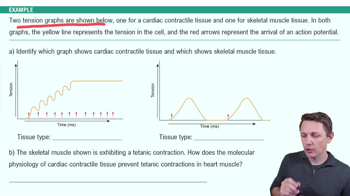
An action potential is an electrical signal that triggers muscle contraction. In cardiac muscle, it propagates rapidly to ensure coordinated heartbeats, enabling the heart to pump blood efficiently.
Recommended video:
Guided course
3:38
Cardiac Action Potentials Example 3

Gap Junctions

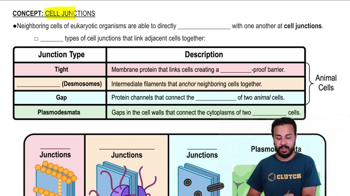
Gap junctions are specialized connections between cardiac muscle cells that allow direct electrical communication. They enable ions and small molecules to pass quickly, facilitating rapid transmission of action potentials.
Recommended video:
05:33
Cell Junctions

Intercalated Discs

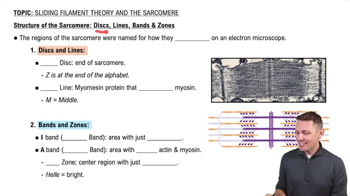
Intercalated discs are complex structures that connect cardiac muscle cells. They contain gap junctions and desmosomes, providing both mechanical strength and electrical connectivity for synchronized contraction.
Recommended video:
Guided course
6:01
Structure of the Sarcomere: Bands, Zones, Discs & Lines