
Ch. 1 An Introduction to Anatomy and Physiology
Martini - Fundamentals of Anatomy & Physiology 11th Edition
Martini, Nath, Bartholomew11th EditionFundamentals of Anatomy & PhysiologyISBN: 9780136874089Not the one you use?Change textbook
Chapter 1, Problem 17

The following is a list of six levels of organization that make up the human body:
(1) Tissue
(2) Cell
(3) Organ
(4) Chemical
(5) Organism
(6) Organ system
The correct order, from the simplest to the most complex level, is
(a) 2, 4, 1, 3, 6, 5
(b) 4, 2, 1, 3, 6, 5
(c) 4, 2, 1, 6, 3, 5
(d) 4, 2, 3, 1, 6, 5
(e) 2, 1, 4, 3, 5, 6

Verified step by step guidance
1
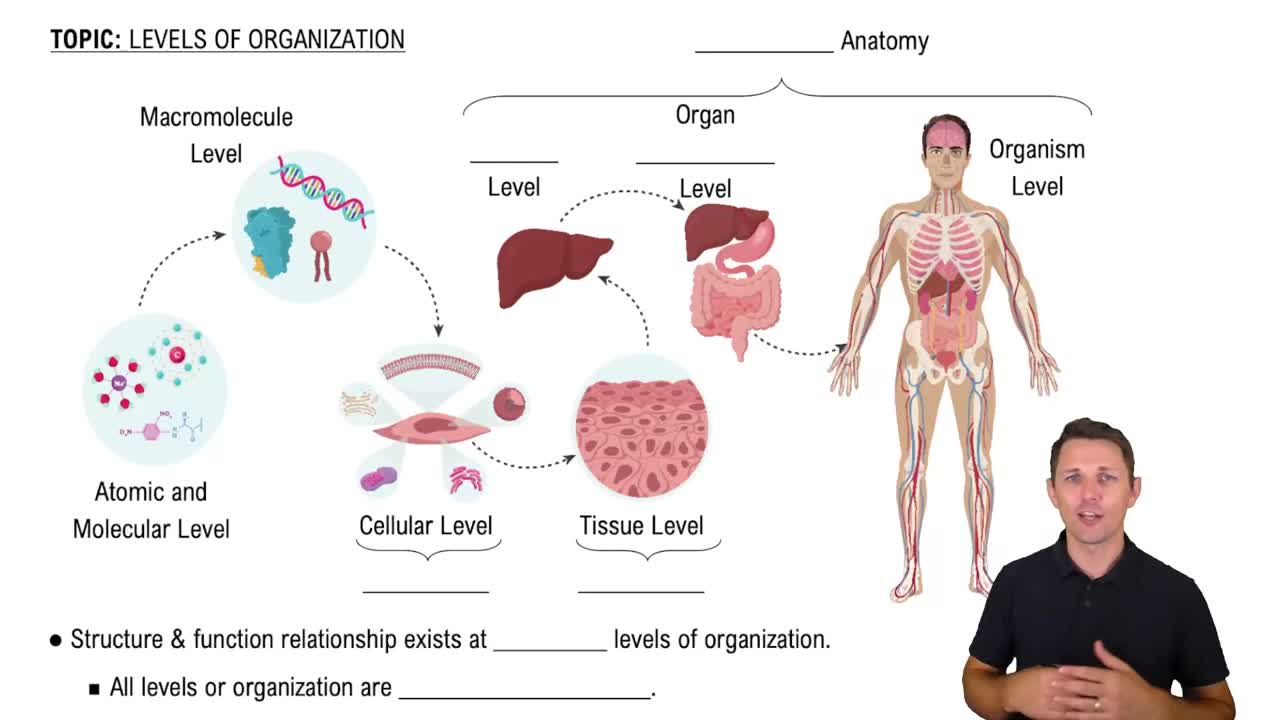
Step 1: Understand the levels of organization in the human body, which range from the simplest to the most complex. The typical hierarchy is Chemical, Cell, Tissue, Organ, Organ System, and Organism.
Step 2: Identify each level from the list given: (4) Chemical, (2) Cell, (1) Tissue, (3) Organ, (6) Organ system, and (5) Organism.
Step 3: Arrange these levels starting with the Chemical level, which includes atoms and molecules, as the simplest building blocks.
Step 4: Next is the Cell level, where molecules combine to form cells, the basic unit of life.
Step 5: Then comes Tissue (groups of similar cells), followed by Organ (structures made of tissues), Organ System (groups of organs working together), and finally Organism (the complete living being).

Verified video answer for a similar problem:

This video solution was recommended by our tutors as helpful for the problem above.
Video duration:
3m
Was this helpful?

Key Concepts

Here are the essential concepts you must grasp in order to answer the question correctly.

Levels of Biological Organization

Biological organization refers to the hierarchy of complex biological structures and systems that define life, starting from the simplest chemical level to the complete organism. Understanding this hierarchy helps in grasping how smaller units combine to form larger, more complex structures.
Recommended video:
Guided course
05:04
The Levels of Organization

Chemical and Cellular Levels

The chemical level includes atoms and molecules essential for life, while the cellular level is the basic unit of life where molecules combine to form cells. Recognizing that chemicals form cells is crucial for ordering these levels correctly.
Recommended video:
Guided course
05:04
The Levels of Organization

Tissues, Organs, Organ Systems, and Organism

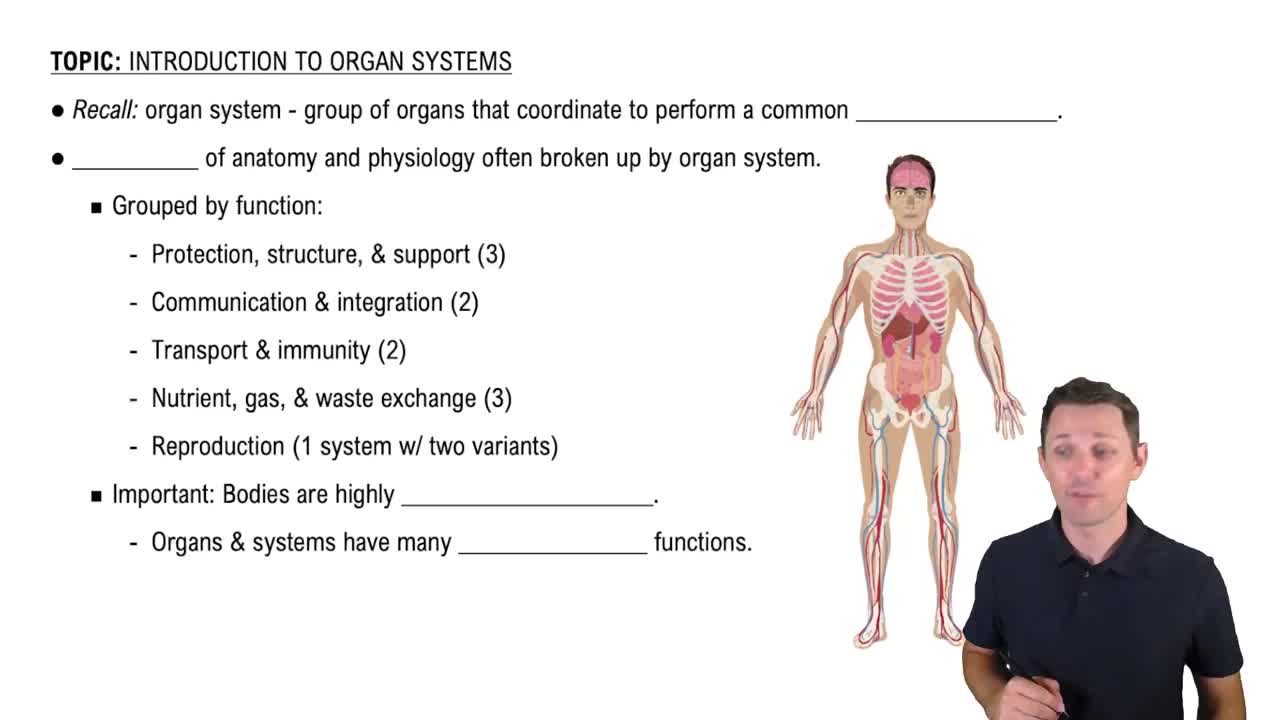
Cells group to form tissues, tissues combine to create organs, organs work together in organ systems, and organ systems collectively make up an organism. This progression from simple to complex structures is key to understanding the correct sequence.
Recommended video:
Guided course
02:29
Introduction to Organ Systems
Related Practice
Textbook Question

Match each numbered item with the most closely related lettered item. Use letters for answers in the spaces provided.

_____Divides thoracic and abdominopelvic body cavities

a. Study of tissues 

b. Constant internal environment 

c. Face-up position 

d. Study of functions 

e. Positive feedback 

f. Organ system 

g. Study of cells 

h. Negative feedback 

i. Serous membrane 

j. Study of internal and external body structures 

k. Diaphragm 

l. Tissue 

m. Peritoneal cavity 

n. Organ 

o. Face-down position

Textbook Question

Match each numbered item with the most closely related lettered item. Use letters for answers in the spaces provided.

_____Abdominopelvic cavity

a. Study of tissues 

b. Constant internal environment 

c. Face-up position 

d. Study of functions 

e. Positive feedback 

f. Organ system 

g. Study of cells 

h. Negative feedback 

i. Serous membrane 

j. Study of internal and external body structures 

k. Diaphragm 

l. Tissue 

m. Peritoneal cavity 

n. Organ 

o. Face-down position

1
views
Textbook Question

A plane through the body that passes perpendicular to the long axis of the body and divides the body into a superior and an inferior section is a

(a) Sagittal section,

(b) Transverse section,

(c) Coronal section,

(d) Frontal section.

1
views
Textbook Question

Which body cavity would enclose each of the following organs?

(a) Heart

(b) Small intestine, large intestine

(c) Lung

(d) Kidneys

Textbook Question

Match each numbered item with the most closely related lettered item. Use letters for answers in the spaces provided.

______Pericardium

a. Study of tissues 

b. Constant internal environment 

c. Face-up position 

d. Study of functions 

e. Positive feedback 

f. Organ system 

g. Study of cells 

h. Negative feedback 

i. Serous membrane 

j. Study of internal and external body structures 

k. Diaphragm 

l. Tissue 

m. Peritoneal cavity 

n. Organ 

o. Face-down position

1
views
Textbook Question

The study of the structure of tissues is called (a) gross anatomy, (b) cytology, (c) histology, (d) organology.

1
views