Ch. 6 Bones and Skeletal Tissues
Marieb - Human Anatomy & Physiology 7th Edition
Marieb, Hoehn7th EditionHuman Anatomy & PhysiologyISBN: 9780805359091Not the one you use?Change textbook
Chapter 6, Problem 12

Osteocytes residing in lacunae of osteons of healthy compact bone are located quite a distance from the blood vessels in the central canals, yet they are well nourished. How can this be explained?

Verified step by step guidance
1
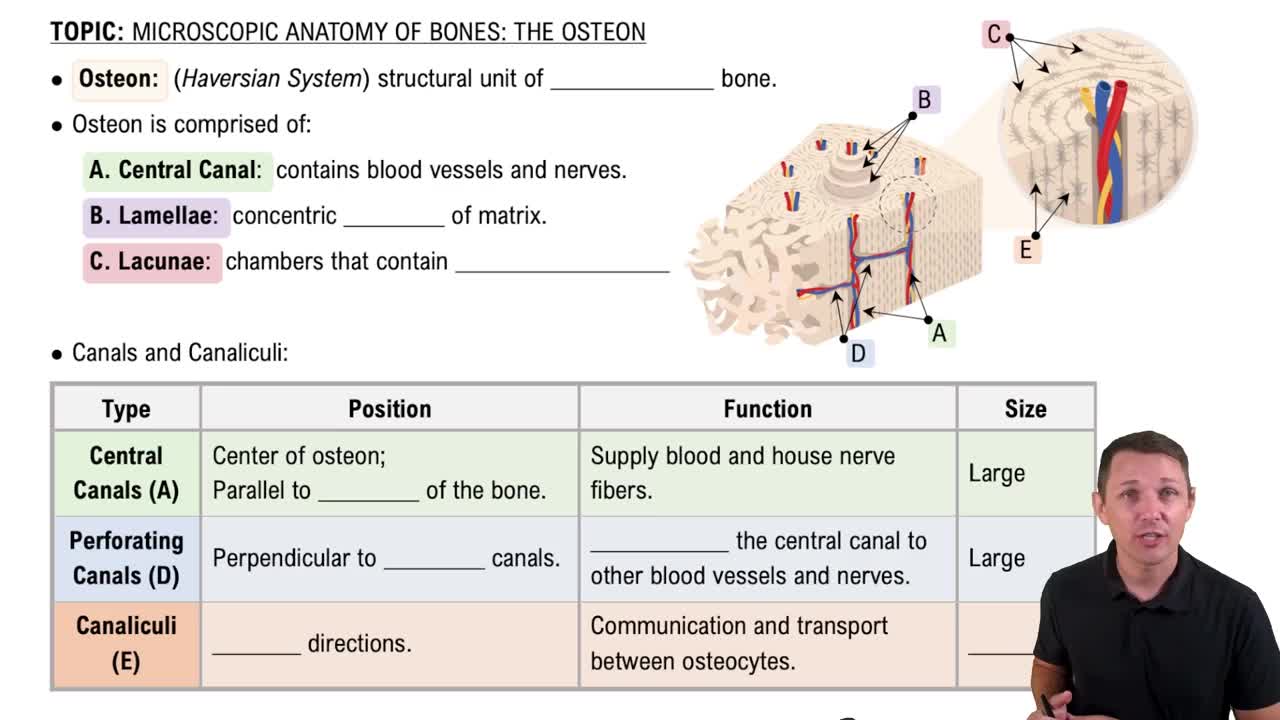
Understand the structure of compact bone, focusing on osteons, which are cylindrical units containing a central canal with blood vessels surrounded by concentric lamellae of bone matrix.
Recognize that osteocytes reside in small spaces called lacunae, which are located between the lamellae and are not directly adjacent to blood vessels.
Identify the presence of tiny channels called canaliculi that radiate from each lacuna and connect osteocytes to each other and to the central canal.
Explain that through these canaliculi, osteocytes extend cytoplasmic processes that allow the exchange of nutrients, oxygen, and waste products by diffusion from the blood vessels in the central canal.
Conclude that this network of canaliculi enables osteocytes to remain well nourished despite their distance from the blood vessels, maintaining bone health and function.

Verified video answer for a similar problem:

This video solution was recommended by our tutors as helpful for the problem above.
Video duration:
2m
Was this helpful?

Key Concepts

Here are the essential concepts you must grasp in order to answer the question correctly.

Structure of Osteons

Osteons are the fundamental functional units of compact bone, consisting of concentric lamellae surrounding a central canal that contains blood vessels. Osteocytes reside in small spaces called lacunae between the lamellae, which are interconnected by tiny channels called canaliculi.
Recommended video:

Role of Canaliculi in Nutrient Transport

Canaliculi are microscopic canals that connect lacunae to each other and to the central canal. They allow the exchange of nutrients, oxygen, and waste products between osteocytes and blood vessels, enabling cells far from the central canal to remain nourished despite the distance.
Recommended video:
02:37
Active Transport

Cellular Communication and Bone Maintenance

Osteocytes communicate through their cytoplasmic extensions within canaliculi, facilitating the transfer of signals and nutrients. This network supports bone maintenance and remodeling by ensuring that even distant osteocytes receive essential substances from the blood supply.
Recommended video:
2:59
Map of the Lesson on Cell Communication