John sustained a severe injury during football practice and is told that he has a torn knee cartilage. Can he expect a quick, uneventful recovery? Explain your response.
Ch. 4 Tissue: The Living Fabric

Marieb, Hoehn7th EditionHuman Anatomy & PhysiologyISBN: 9780805359091Not the one you use?Change textbook
Chapter 4, Problem 14
Differentiate between the roles of neurons and the supporting cells of nervous tissue.
Verified step by step guidance1
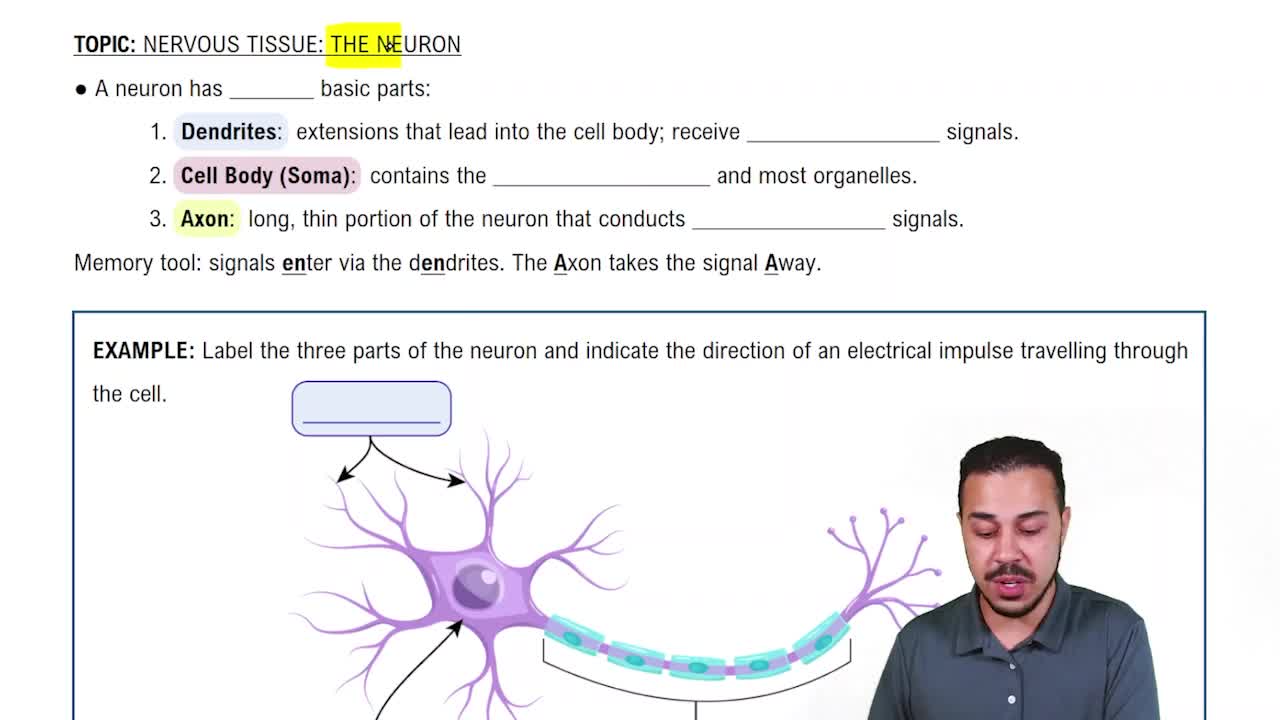
Step 1: Define neurons by explaining that they are the primary functional cells of the nervous system responsible for transmitting electrical signals throughout the body. Highlight their role in receiving, processing, and sending information via nerve impulses.
Step 2: Describe the structure of neurons, including the cell body (soma), dendrites (which receive signals), and axons (which transmit signals to other neurons or effectors). This helps clarify how neurons perform their communication role.
Step 3: Introduce supporting cells, also known as neuroglia or glial cells, and explain that they do not conduct electrical impulses but provide essential support functions to neurons.
Step 4: Differentiate the roles of supporting cells by listing their key functions such as providing structural support, supplying nutrients, maintaining the extracellular environment, insulating axons with myelin, and participating in repair and immune defense within the nervous system.
Step 5: Summarize by contrasting neurons as the signal transmitters with supporting cells as the caretakers that ensure neurons function efficiently and remain healthy.

Verified video answer for a similar problem:
This video solution was recommended by our tutors as helpful for the problem above.
Video duration:
1mWas this helpful?
Key Concepts
Here are the essential concepts you must grasp in order to answer the question correctly.
Neurons
Neurons are the primary signaling cells of the nervous system responsible for transmitting electrical impulses. They process and communicate information through specialized structures like dendrites, axons, and synapses, enabling sensory input, motor output, and cognitive functions.
Recommended video:
Guided course
The Neuron
Supporting Cells (Neuroglia)
Supporting cells, or neuroglia, provide structural and metabolic support to neurons. They maintain homeostasis, form myelin, protect against pathogens, and assist in repair processes, ensuring the proper functioning and health of nervous tissue.
Recommended video:
Support Structures
Functional Differences Between Neurons and Supporting Cells
While neurons conduct electrical signals, supporting cells do not transmit impulses but instead support neurons physically and chemically. This distinction highlights their complementary roles: neurons handle communication, and supporting cells maintain the environment necessary for neuronal activity.
Recommended video:
Cell Junctions
Related Practice
Textbook Question
2
views
Textbook Question
Name four important functions of epithelial tissue and provide at least one example of a tissue that exemplifies each function.
Textbook Question
Matrix is extracellular. How does the matrix get to its characteristic position?
Textbook Question
Provide examples from the body that illustrate four of the major functions of connective tissue.
4
views
Textbook Question
Compare and contrast skeletal, cardiac, and smooth muscle tissue relative to structure, body location, and specific function.
1
views
Textbook Question
Mrs. Delancy went to the local meat market and bought a beef tenderloin (cut from the loin, the region along the steer's caudal vertebral column) and some tripe (cow's stomach). What type of muscle was she preparing to eat in each case?
1
views