Ch. 19 The Cardiovascular System: Blood Vessels
Marieb - Human Anatomy & Physiology 7th Edition
Marieb, Hoehn7th EditionHuman Anatomy & PhysiologyISBN: 9780805359091Not the one you use?Change textbook
Chapter 18, Problem 7

The baroreceptors in the carotid sinus and aortic arch are sensitive to
a. a decrease in CO₂
b. changes in arterial pressure
c. a decrease in O₂
d. all of these

Verified step by step guidance
1
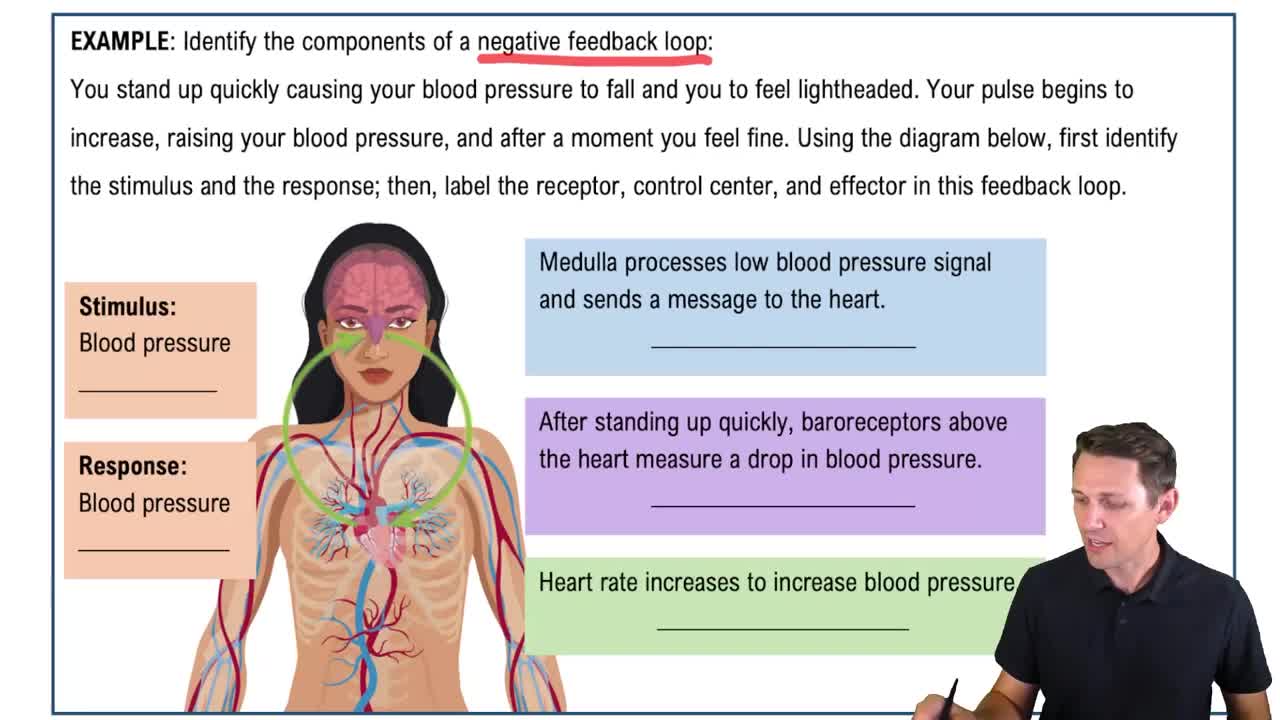
Understand the role of baroreceptors: Baroreceptors are specialized sensory nerve endings located in the walls of certain blood vessels, such as the carotid sinus and aortic arch. Their primary function is to detect changes in blood pressure.
Identify what baroreceptors respond to: Baroreceptors are sensitive to the stretch of the blood vessel walls, which corresponds to changes in arterial pressure. When blood pressure rises, the vessel walls stretch more, and when it falls, they stretch less.
Differentiate baroreceptors from chemoreceptors: Chemoreceptors, not baroreceptors, are responsible for detecting changes in blood gases such as CO₂ and O₂ levels. These are located in similar regions but serve a different function.
Conclude the correct sensitivity: Since baroreceptors respond specifically to changes in arterial pressure, the correct answer is that they are sensitive to changes in arterial pressure.
Summarize: Therefore, the baroreceptors in the carotid sinus and aortic arch detect changes in arterial pressure, not changes in CO₂ or O₂ levels.

Verified video answer for a similar problem:

This video solution was recommended by our tutors as helpful for the problem above.
Video duration:
2m
Was this helpful?

Key Concepts

Here are the essential concepts you must grasp in order to answer the question correctly.

Baroreceptors

Baroreceptors are specialized sensory nerve endings located in blood vessels like the carotid sinus and aortic arch. They detect changes in the stretch of the vessel walls, which corresponds to changes in blood pressure, and send signals to the brain to help regulate cardiovascular function.
Recommended video:
Guided course
03:00
Feedback Loops: Negative Feedback Example 1

Carotid Sinus and Aortic Arch

The carotid sinus and aortic arch are key sites where baroreceptors are found. These areas monitor arterial pressure and provide critical feedback to maintain stable blood pressure by adjusting heart rate and vessel diameter.
Recommended video:
Guided course
2:13
The Skull Example 4

Sensitivity to Arterial Pressure Changes

Baroreceptors primarily respond to changes in arterial pressure, not directly to levels of gases like CO₂ or O₂. When blood pressure rises or falls, baroreceptors alter their firing rate to trigger reflexes that restore normal pressure.
Recommended video:
3:23
Introduction to Arteries
Related Practice
Textbook Question

The myocardium receives its blood supply directly from the:

a. Aorta

b. Coronary arteries

c. Coronary sinus

d. Pulmonary arteries

1
views
Textbook Question

Blood flow in the capillaries is steady despite the rhythmic pumping of the heart because of the:

a. Elasticity of the large arteries

b. Small diameter of capillaries

c. Thin walls of the veins

d. Venous valves

1
views
Textbook Question

Using the letters from column B, match the artery descriptions in column A. (Note that some require more than a single choice.)

Column A 

____  (1) unpaired branch of abdominal aorta 

____  (2) second branch of aortic arch 

____ 3) branch of internal carotid 

____ (4) branch of external carotid 

____  (5) origin of femoral arteries

Column B

a. right common carotid

b. superior mesenteric

c. left common carotid

d. external iliac

e. inferior mesenteric

f. superficial temporal

g. celiac trunk

h. facial

i. ophthalmic

j. internal iliac

1
views
Textbook Question

Arterial blood pressure increases in response to:

a. increasing stroke volume

b. increasing heart rate

c. atherosclerosis

d. rising blood volume

e. all of these

1
views
Textbook Question

Which of the following would not result in the dilation of the terminal arterioles and upstream arterioles in systemic capillary beds?

a. A decrease in local tissue O₂ content

b. An increase in local tissue CO₂

c. A local increase in histamine

d. A local increase in pH

2
views
Textbook Question

The structure of a capillary wall differs from that of a vein or an artery because

a. it has two tunics instead of three

b. there is less smooth muscle

c. it has a single tunic—only the tunica intima

d. none of these

1
views