Ch. 19 The Cardiovascular System: Blood Vessels
Marieb - Human Anatomy & Physiology 7th Edition
Marieb, Hoehn7th EditionHuman Anatomy & PhysiologyISBN: 9780805359091Not the one you use?Change textbook
Chapter 18, Problem 22

How does the control of blood flow to the skin for the purpose of regulating body temperature differ from the control of nutrient blood flow to skin cells?

Verified step by step guidance
1
Step 1: Understand that blood flow to the skin serves two main purposes: thermoregulation (controlling body temperature) and supplying nutrients to skin cells for metabolism and maintenance.
Step 2: Recognize that thermoregulatory blood flow is primarily controlled by the autonomic nervous system, specifically through sympathetic vasoconstrictor and vasodilator nerves that adjust the diameter of blood vessels in response to body temperature changes.
Step 3: Note that when the body needs to lose heat, blood vessels in the skin dilate (vasodilation) to increase blood flow and promote heat loss; conversely, when conserving heat, vessels constrict (vasoconstriction) to reduce blood flow and heat loss.
Step 4: Contrast this with nutrient blood flow, which is regulated mainly by local metabolic factors within the skin tissue itself, such as oxygen demand, carbon dioxide levels, and other chemical signals that cause local vasodilation or vasoconstriction to meet cellular needs.
Step 5: Summarize that thermoregulatory control is systemic and neural, rapidly adjusting blood flow based on temperature signals, while nutrient blood flow control is more localized and dependent on the metabolic activity of skin cells.

Verified video answer for a similar problem:

This video solution was recommended by our tutors as helpful for the problem above.
Was this helpful?

Key Concepts

Here are the essential concepts you must grasp in order to answer the question correctly.

Thermoregulatory Blood Flow

Thermoregulatory blood flow involves adjusting the amount of blood reaching the skin to either dissipate heat or conserve it. This process is controlled by the autonomic nervous system, primarily through vasodilation and vasoconstriction of skin blood vessels, helping maintain stable body temperature.
Recommended video:
6:40
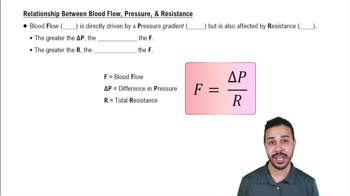
Relationship Between Blood Flow, Pressure, & Resistance

Nutrient Blood Flow to Skin Cells

Nutrient blood flow refers to the delivery of oxygen and essential nutrients to skin cells to support their metabolism and function. This flow is relatively constant and regulated locally by metabolic demand rather than by systemic temperature control mechanisms.
Recommended video:
6:40
Relationship Between Blood Flow, Pressure, & Resistance

Vasomotor Control Mechanisms

Vasomotor control involves neural and chemical signals that regulate blood vessel diameter. For thermoregulation, sympathetic nerves adjust vessel tone rapidly, while nutrient flow depends more on local factors like tissue oxygen levels and metabolic byproducts to modulate blood supply.
Recommended video:
2:05
Control of the ANS Example 2
Related Practice
Textbook Question

Explain the reasons for the observed changes in blood flow velocity in the different regions of the circulation.

1
views
Textbook Question

A 60-year-old man is unable to walk more than 100 yards without experiencing severe pain in his left leg; the pain is relieved by resting for 5–10 minutes. He is told that the arteries of his leg are becoming occluded with fatty material and is advised to have the sympathetic nerves serving that body region severed. Explain how such surgery might help to relieve this man's problem.

1
views
Textbook Question

Write an equation showing the relationship between total peripheral resistance, blood flow, and blood pressure.

2
views
Textbook Question

Distinguish between elastic arteries, muscular arteries, and arterioles relative to location, histology, and functional adaptations.

1
views
Textbook Question

Your friend Jillian, who knows little about science, is reading a magazine article about a patient who had an 'aneurysm at the base of his brain that suddenly grew much larger.' The surgeons' first goal was to 'keep it from rupturing,' and the second goal was to 'relieve the pressure on the brain stem and cranial nerves.' The surgeons were able to 'replace the aneurysm with a section of plastic tubing,' so the patient recovered. Jillian asks you what all this means. Explain.

1
views
Textbook Question

Describe neural and chemical (both systemic and local) effects exerted on the blood vessels when you are fleeing from a mugger. (Be careful, this is more involved than it appears at first glance.)

1
views