Discuss how the Frank-Starling law of the heart helps to explain the influence of venous return on stroke volume.
Ch. 18 The Cardiovascular System: The Heart

Marieb, Hoehn7th EditionHuman Anatomy & PhysiologyISBN: 9780805359091Not the one you use?Change textbook
Chapter 17, Problem 22
Florita Santos, a middle-aged woman, is admitted to the coronary care unit with a diagnosis of left ventricular failure resulting from a myocardial infarction. Her history indicates that she awoke in the middle of the night with severe chest pain. Her skin is pale and cold, and moist sounds are heard over the lower regions of both lungs. Explain how failure of the left ventricle can cause these signs and symptoms.
Verified step by step guidance1
Understand the role of the left ventricle: The left ventricle is responsible for pumping oxygenated blood from the lungs into the systemic circulation, supplying the body with oxygen and nutrients.
Recognize what happens in left ventricular failure: When the left ventricle fails, it cannot effectively pump blood out to the body, causing blood to back up into the left atrium and then into the pulmonary veins and lungs.
Explain pulmonary congestion and edema: The increased pressure in the pulmonary circulation causes fluid to leak from the capillaries into the lung tissue and alveoli, leading to moist crackling sounds (rales) heard over the lower lungs and difficulty breathing.
Connect systemic effects: Because less blood is pumped into systemic circulation, tissues receive less oxygen, causing symptoms like pale, cold skin due to vasoconstriction and reduced peripheral perfusion.
Relate chest pain and myocardial infarction: The initial myocardial infarction damaged the heart muscle, impairing left ventricular function and triggering the cascade of symptoms described.

Verified video answer for a similar problem:
This video solution was recommended by our tutors as helpful for the problem above.
Video duration:
1mWas this helpful?
Key Concepts
Here are the essential concepts you must grasp in order to answer the question correctly.
Left Ventricular Failure
Left ventricular failure occurs when the left ventricle cannot pump blood effectively, leading to reduced cardiac output. This causes blood to back up into the lungs, increasing pressure in pulmonary vessels and impairing oxygen exchange, which results in symptoms like shortness of breath and fluid accumulation.
Recommended video:
Guided course
Introduction to Homeostasis
Pulmonary Congestion and Edema
When the left ventricle fails, blood accumulates in the pulmonary circulation, causing fluid to leak into lung tissues and air spaces. This pulmonary edema produces moist crackles on auscultation and contributes to respiratory distress, as seen in the moist lung sounds and difficulty breathing.
Recommended video:
Guided course
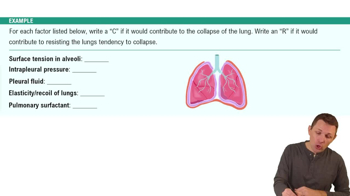
Pressure in the Lungs and Pleural Cavity Example 1
Signs of Poor Perfusion in Heart Failure
Reduced cardiac output from left ventricular failure leads to inadequate blood flow to tissues, causing pale, cold, and clammy skin due to vasoconstriction and sympathetic activation. These signs reflect the body's attempt to maintain vital organ perfusion despite heart dysfunction.
Recommended video:
Guided course
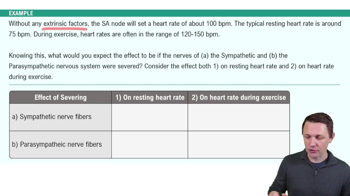
Electrical Conduction System of the Heart Example 3
Related Practice
Textbook Question
2
views
Textbook Question
Name the elements of the intrinsic conduction system of the heart in order, beginning with the pacemaker
What is the important function of this conduction system?
1
views
Textbook Question
You have been called upon to demonstrate the technique for listening to valve sounds.
Explain where you would position your stethoscope to auscultate.
(1) the aortic valve of a patient with severe aortic valve insufficiency and
(2) a stenotic mitral valve.
During which period(s) would you hear these abnormal valve sounds most clearly? (During atrial diastole, ventricular systole, ventricular diastole, or atrial systole?)
What cues would you use to differentiate between an insufficient and a stenotic valve?
1
views