Ch. 13 The Peripheral Nervous System and Reflex Activity
Marieb - Human Anatomy & Physiology 7th Edition
Marieb, Hoehn7th EditionHuman Anatomy & PhysiologyISBN: 9780805359091Not the one you use?Change textbook
Chapter 13, Problem 24

Which of the following is important in maintaining the balance of the body?
a. Visual cues
b. Semicircular canals
c. The saccule
d. Proprioceptors
e. All of these

Verified step by step guidance
1
Step 1: Understand the concept of balance in the human body. Balance is maintained by the integration of sensory information from multiple systems including the visual system, vestibular system, and proprioceptive system.
Step 2: Recognize the role of visual cues (option a). Visual input helps the brain understand the body's position relative to the environment, which is crucial for maintaining balance.
Step 3: Identify the function of the semicircular canals (option b). These structures in the inner ear detect rotational movements of the head and contribute to the vestibular system, which is essential for balance.
Step 4: Consider the saccule (option c). The saccule is part of the vestibular system and detects vertical acceleration and head position relative to gravity, aiding balance.
Step 5: Understand proprioceptors (option d). These sensory receptors in muscles and joints provide information about body position and movement, which is vital for balance control.

Verified video answer for a similar problem:

This video solution was recommended by our tutors as helpful for the problem above.
Video duration:
2m
Was this helpful?

Key Concepts

Here are the essential concepts you must grasp in order to answer the question correctly.

Semicircular Canals

Semicircular canals are three fluid-filled structures in the inner ear that detect rotational movements of the head. They play a crucial role in maintaining balance by sending signals to the brain about head position and motion, helping coordinate eye and body movements.
Recommended video:
Guided course
5:05
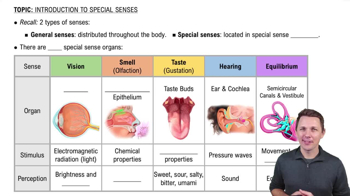
Special Senses

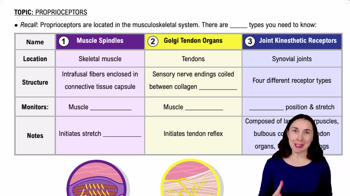
Proprioceptors

Proprioceptors are sensory receptors located in muscles, tendons, and joints that provide information about body position and movement. They help the brain understand limb orientation and movement, which is essential for maintaining posture and balance.
Recommended video:
3:52
Proprioceptors

Visual Cues

Visual cues refer to the information the eyes provide about the environment and body position relative to surroundings. This sensory input helps the brain maintain balance by integrating visual information with signals from the inner ear and proprioceptors.
Recommended video:
02:52
Types of Electron Microscopes