When admitted to the emergency room, Sean was holding his right hand, which had a deep puncture hole in its palm. He explained that he had fallen on a nail while exploring a barn. Sean was given an antitetanus shot to prevent neural complications. Tetanus bacteria fester in deep, dark wounds, but how do their toxins travel in neural tissue?
Ch. 11 Fundamentals of the Nervous System and Nervous Tissue

Marieb, Hoehn7th EditionHuman Anatomy & PhysiologyISBN: 9780805359091Not the one you use?Change textbook
All textbooks
Marieb, Hoehn 7th Edition
Ch. 11 Fundamentals of the Nervous System and Nervous Tissue
Problem 20
Marieb, Hoehn 7th Edition
Ch. 11 Fundamentals of the Nervous System and Nervous Tissue
Problem 20Chapter 11, Problem 20
Since at any moment a neuron is likely to have thousands of neurons releasing neurotransmitters at its surface, how is neuronal activity (to fire or not to fire) determined?
Verified step by step guidance1
Understand that a neuron receives inputs from many other neurons through synapses, where neurotransmitters are released and bind to receptors on the neuron's membrane.
Recognize that these inputs can be excitatory or inhibitory, meaning they either increase or decrease the likelihood that the neuron will generate an action potential (fire).
Learn that the neuron integrates all these excitatory and inhibitory postsynaptic potentials (EPSPs and IPSPs) by summing them spatially (across different synapses) and temporally (over time).
Focus on the concept of the axon hillock, the region where the neuron decides whether to fire an action potential based on whether the combined membrane potential reaches a certain threshold.
Conclude that neuronal activity is determined by whether the net effect of all incoming signals depolarizes the membrane potential at the axon hillock enough to reach the threshold for firing an action potential.

Verified video answer for a similar problem:
This video solution was recommended by our tutors as helpful for the problem above.
Video duration:
2mWas this helpful?
Key Concepts
Here are the essential concepts you must grasp in order to answer the question correctly.
Synaptic Integration
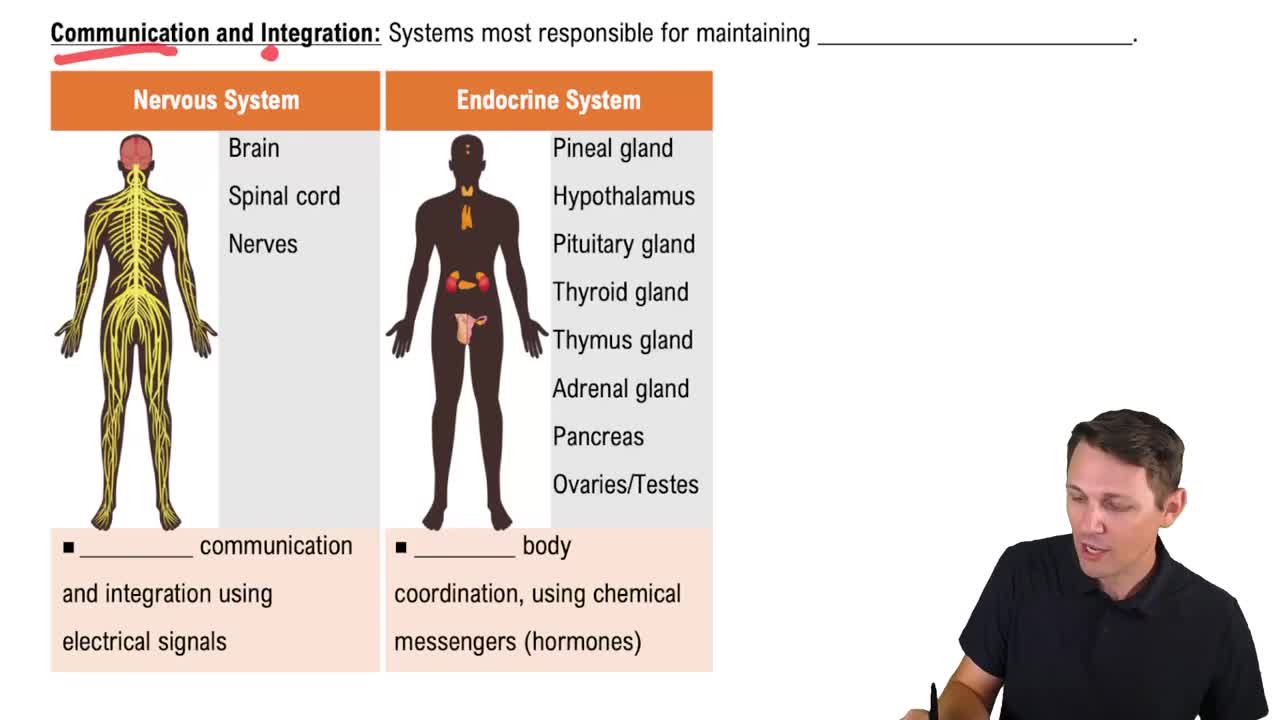
Synaptic integration is the process by which a neuron combines multiple excitatory and inhibitory inputs received from thousands of synapses. The neuron sums these inputs spatially and temporally to determine whether the overall signal reaches the threshold to trigger an action potential.
Recommended video:
Guided course
Communication and Integration
Action Potential Threshold
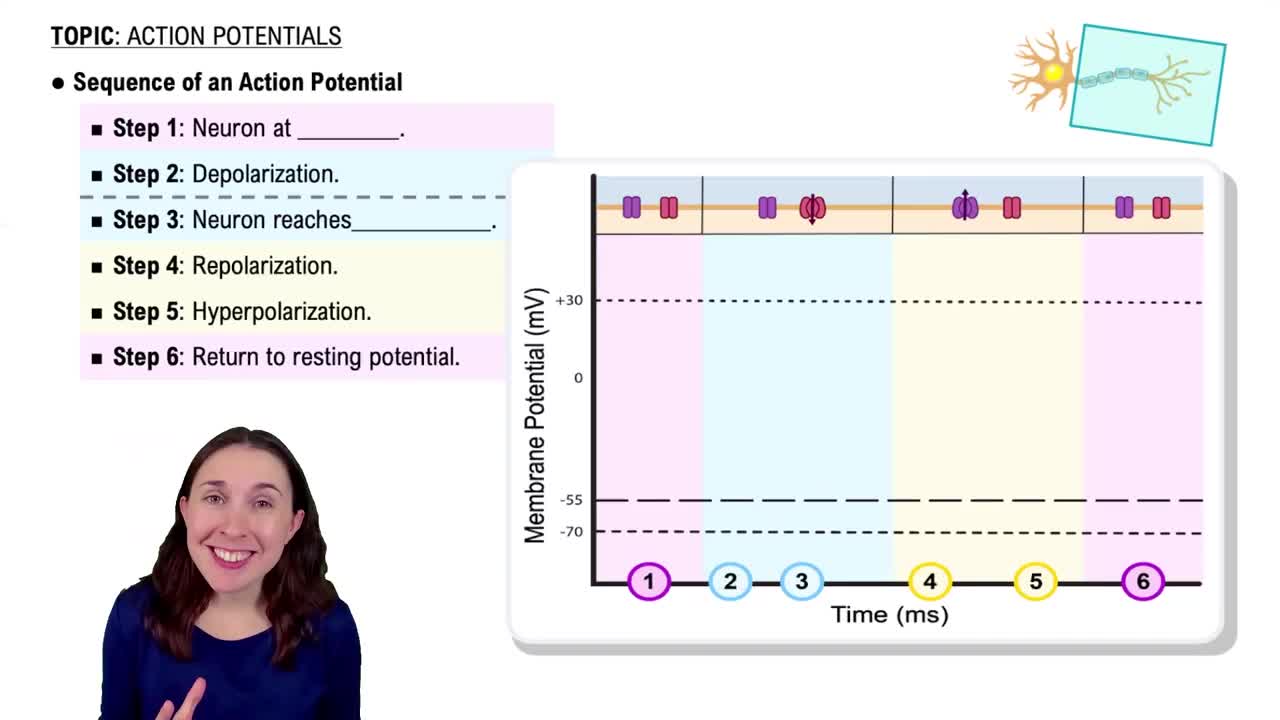
The action potential threshold is the critical level of membrane depolarization that must be reached for a neuron to fire. If the combined synaptic inputs depolarize the membrane beyond this threshold, voltage-gated ion channels open, initiating the action potential.
Recommended video:
Action Potential
Excitatory and Inhibitory Neurotransmitters
Neurotransmitters can be excitatory, increasing the likelihood of firing by depolarizing the neuron, or inhibitory, decreasing it by hyperpolarizing the membrane. The balance between these opposing signals determines the neuron's overall response.
Recommended video:
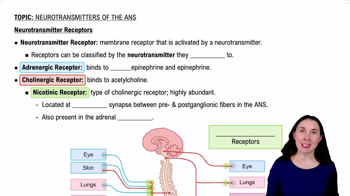
Neurotransmitter Receptors
Related Practice
Textbook Question
7
views
Textbook Question
The effects of neurotransmitter binding are very brief. Explain.
1
views
Textbook Question
a. Contrast unipolar, bipolar, and multipolar neurons structurally.
b. Indicate where each is most likely to be found.
1
views
Textbook Question
Describe the events that must occur to generate an AP. Relate the sequence of changes in permeability to changes in the ion channels, and explain why the AP is an all-or-none phenomenon.
3
views
Textbook Question
What is the polarized membrane state? How is it maintained? (Note the relative roles of both passive and active mechanisms.)
5
views
Textbook Question
Explain both the anatomical and functional divisions of the nervous system. Include the subdivisions of each.