Ch. 11 Fundamentals of the Nervous System and Nervous Tissue
Marieb - Human Anatomy & Physiology 7th Edition
Marieb, Hoehn7th EditionHuman Anatomy & PhysiologyISBN: 9780805359091Not the one you use?Change textbook
Chapter 11, Problem 2

Match the names of the supporting cells found in column B with the appropriate descriptions in column A.
Column A 
_______ (1) myelinates nerve fibers in the CNS 
_______ (2) lines brain cavities 
_______ (3) myelinates nerve fibers in the PNS 
_______ (4) CNS phagocyte
________(5) helps regulate the ionic composition of CNS extracellular fluid
Column B
a. Astrocyte
b. Ependymal cell
c. Microglial cell
d. Oligodendrocyte
e. Satellite cell
f. Schwann cell

Verified step by step guidance
1
Step 1: Understand the roles of each supporting cell type listed in Column B. For example, oligodendrocytes and Schwann cells are known for myelination, but in different parts of the nervous system.
Step 2: Identify which cells myelinate nerve fibers in the CNS and PNS. Oligodendrocytes myelinate multiple axons in the CNS, while Schwann cells myelinate single axons in the PNS.
Step 3: Determine which cell lines the brain cavities. Ependymal cells form the epithelial-like lining of the brain's ventricles and spinal cord central canal.
Step 4: Recognize the CNS phagocyte, which is the microglial cell responsible for immune defense and cleaning debris in the CNS.
Step 5: Match the cell that helps regulate the ionic composition of the CNS extracellular fluid, which is the astrocyte, known for maintaining the environment around neurons.

Verified video answer for a similar problem:

This video solution was recommended by our tutors as helpful for the problem above.
Video duration:
6m
Was this helpful?

Key Concepts

Here are the essential concepts you must grasp in order to answer the question correctly.

Supporting Cells of the Central Nervous System (CNS)

Supporting cells in the CNS include oligodendrocytes, astrocytes, microglia, and ependymal cells. Each has a specific role such as myelination, structural support, immune defense, or lining brain cavities. Understanding their functions helps in identifying their descriptions and matching them correctly.
Recommended video:
1:32
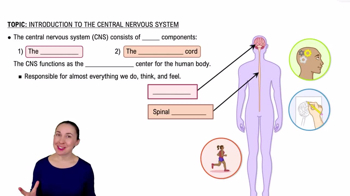
The Central Nervous System

Myelination in the CNS and PNS

Myelination is the process of forming a myelin sheath around nerve fibers to increase signal speed. Oligodendrocytes myelinate axons in the CNS, while Schwann cells perform this role in the PNS. Recognizing which cell myelinates where is crucial for matching questions.
Recommended video:
3:34
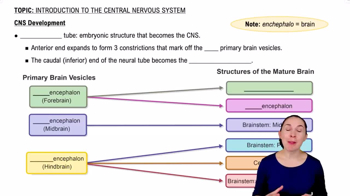
CNS Development

Functions of Specific Supporting Cells

Astrocytes regulate the ionic environment and provide structural support; microglial cells act as immune phagocytes in the CNS; ependymal cells line brain cavities and help circulate cerebrospinal fluid; satellite cells support neurons in the PNS. Knowing these roles aids in accurate cell-function matching.
Recommended video:
05:33
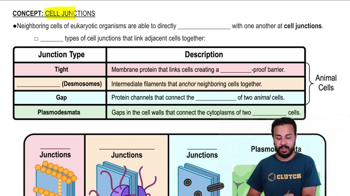
Cell Junctions