Ch. 7 The Nervous System
Marieb - Essentials of Human Anatomy & Physiology 13th Edition
Marieb13th EditionEssentials of Human Anatomy & PhysiologyISBN: 9780135624340Not the one you use?Change textbook
Chapter 7, Problem 4

Histological examination of a slice of neural tissue reveals a bundle of nerve fibers held together by cells whose multiple processes wrap around several fibers and form a myelin sheath. The specimen is likely to be:
a. A nucleus
b. A ganglion
c. A nerve
d. A tract

Verified step by step guidance
1
Step 1: Understand the key terms in the problem. A 'myelin sheath' is a protective covering that surrounds nerve fibers, aiding in the rapid transmission of electrical signals. Cells that form myelin sheaths in the central nervous system are oligodendrocytes, while in the peripheral nervous system, Schwann cells perform this function.
Step 2: Analyze the structural organization of the nervous system. A 'nucleus' refers to a cluster of neuron cell bodies in the central nervous system (CNS), while a 'ganglion' refers to a cluster of neuron cell bodies in the peripheral nervous system (PNS). Neither of these structures involves bundles of nerve fibers wrapped in myelin.
Step 3: Examine the terms 'nerve' and 'tract.' A 'nerve' is a bundle of nerve fibers (axons) in the peripheral nervous system, while a 'tract' is a bundle of nerve fibers in the central nervous system. Both structures can be associated with myelin sheaths.
Step 4: Consider the histological description provided. The presence of cells with multiple processes wrapping around several fibers suggests oligodendrocytes, which are found in the CNS. This detail points toward the specimen being a 'tract' rather than a 'nerve,' as Schwann cells in the PNS typically wrap around individual fibers.
Step 5: Conclude that the specimen is likely to be a 'tract' based on the histological evidence of myelin sheaths formed by cells with multiple processes. However, if the description matches Schwann cells, the specimen could be a 'nerve.'

Verified video answer for a similar problem:

This video solution was recommended by our tutors as helpful for the problem above.
Video duration:
2m
Was this helpful?

Key Concepts

Here are the essential concepts you must grasp in order to answer the question correctly.

Myelin Sheath

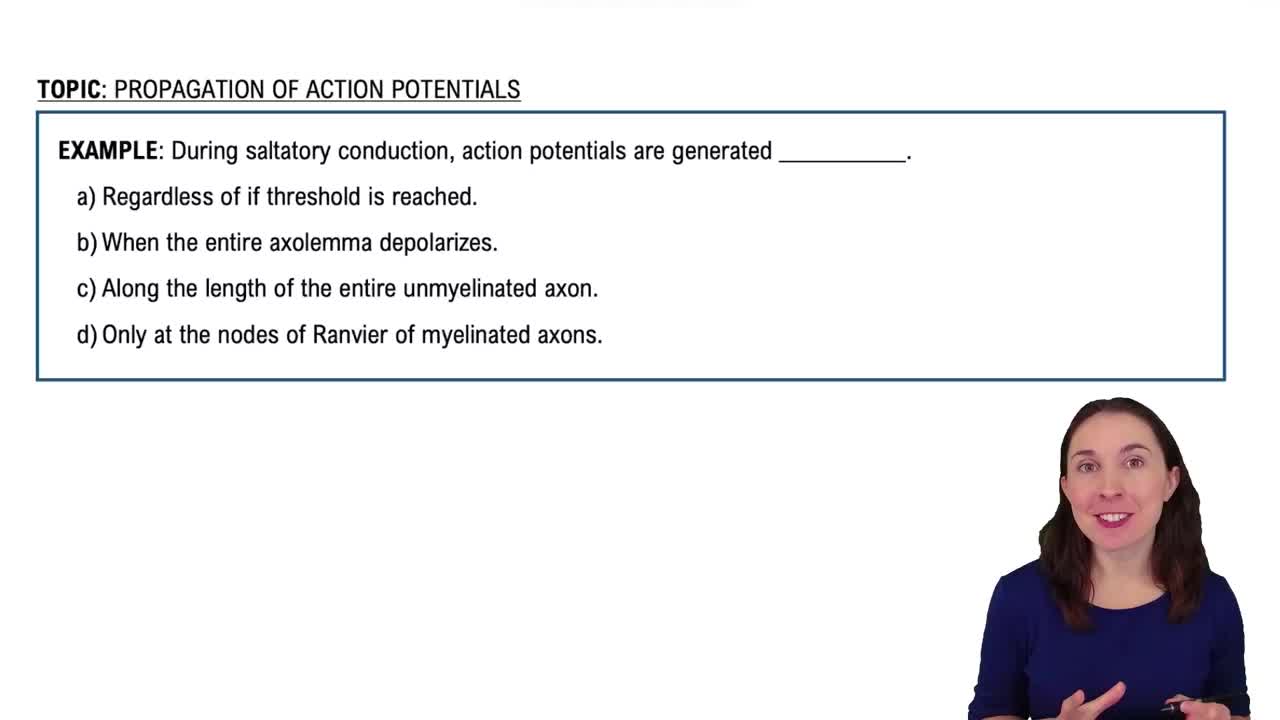
The myelin sheath is a protective covering that surrounds nerve fibers, formed by glial cells. It serves to insulate the axons, allowing for faster transmission of electrical signals along the nerve fibers. In the central nervous system, oligodendrocytes create the myelin sheath, while in the peripheral nervous system, Schwann cells are responsible for its formation.
Recommended video:
02:01
Propagation of Action Potentials Example 1

Nerve Structure

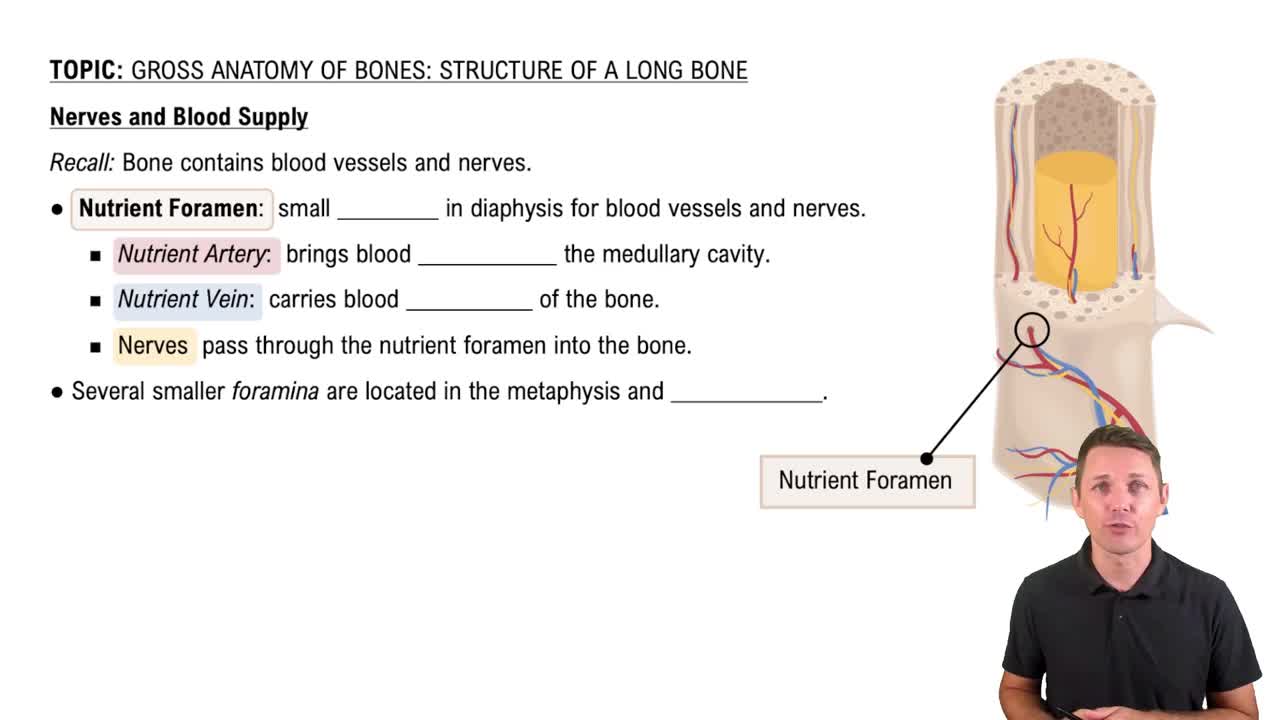
A nerve is a bundle of axons in the peripheral nervous system, encased in connective tissue. Nerves transmit signals between the central nervous system and the rest of the body, facilitating communication and coordination of bodily functions. The presence of a myelin sheath indicates that the nerve fibers are likely involved in rapid signal transmission.
Recommended video:
Guided course
2:25
Nerves and Blood Supply

Neural Tissue Examination

Histological examination involves studying the microscopic structure of tissues. In neural tissue, identifying the arrangement of nerve fibers and the presence of myelin sheaths can help differentiate between various structures, such as nerves, tracts, and ganglia. This examination is crucial for understanding the organization and function of the nervous system.
Recommended video:
1:52
External Regulation – Neural Mechanisms