Ch. 6 The Muscular System
Marieb - Essentials of Human Anatomy & Physiology 13th Edition
Marieb13th EditionEssentials of Human Anatomy & PhysiologyISBN: 9780135624340Not the one you use?Change textbook
Chapter 6, Problem 15

The hamstring and quadriceps muscle groups are antagonists of each other, and each group is a prime mover in its own right. What action does each muscle group perform?

Verified step by step guidance
1
Understand the concept of antagonistic muscle groups: Antagonistic muscles work in pairs, where one muscle contracts (the prime mover or agonist) to produce a specific movement, and the opposing muscle relaxes (the antagonist) to allow the movement to occur.
Identify the hamstring muscle group: The hamstrings are located on the posterior (back) side of the thigh and include three muscles—biceps femoris, semitendinosus, and semimembranosus. These muscles are responsible for flexing the knee and extending the hip joint.
Identify the quadriceps muscle group: The quadriceps are located on the anterior (front) side of the thigh and include four muscles—rectus femoris, vastus lateralis, vastus medialis, and vastus intermedius. These muscles are responsible for extending the knee and flexing the hip joint.
Determine the actions of the hamstrings: When the hamstrings act as the prime mover, they perform knee flexion (bending the knee) and hip extension (moving the thigh backward).
Determine the actions of the quadriceps: When the quadriceps act as the prime mover, they perform knee extension (straightening the knee) and hip flexion (lifting the thigh forward).

Verified video answer for a similar problem:

This video solution was recommended by our tutors as helpful for the problem above.
Video duration:
1m
Was this helpful?

Key Concepts

Here are the essential concepts you must grasp in order to answer the question correctly.

Antagonistic Muscle Groups

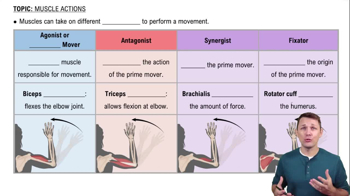
Antagonistic muscle groups consist of pairs of muscles that work against each other to create movement. When one muscle contracts, the other relaxes, allowing for controlled motion. In this context, the hamstrings and quadriceps are antagonists, meaning they perform opposing actions during leg movements.
Recommended video:
06:04
Functional Groups

Prime Movers

Prime movers, or agonists, are the muscles primarily responsible for a specific movement. In the case of the quadriceps, they are the prime movers for knee extension, while the hamstrings serve as prime movers for knee flexion. Understanding which muscles act as prime movers helps clarify their roles in various physical activities.
Recommended video:
Guided course
5:41
Muscle Actions

Muscle Actions

Muscle actions refer to the specific movements produced by muscle contractions. The quadriceps facilitate knee extension, straightening the leg, while the hamstrings enable knee flexion, bending the leg. Recognizing these actions is essential for understanding how these muscle groups contribute to overall leg movement and stability.
Recommended video:
Guided course
5:41
Muscle Actions