Ch. 5 The Skeletal System
Marieb - Essentials of Human Anatomy & Physiology 13th Edition
Marieb13th EditionEssentials of Human Anatomy & PhysiologyISBN: 9780135624340Not the one you use?Change textbook
Chapter 5, Problem 15

What facial bone forms the chin? The cheekbone? The upper jaw? The bony eyebrow ridges?

Verified step by step guidance
1
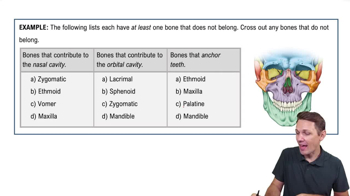
Identify the facial bone that forms the chin: The chin is formed by the mandible, which is the lower jawbone. It is the largest and strongest bone of the face and provides support for the lower teeth.
Determine the facial bone that forms the cheekbone: The cheekbone is formed by the zygomatic bone. This bone contributes to the prominence of the cheeks and forms part of the lateral wall and floor of the orbit (eye socket).
Locate the facial bone that forms the upper jaw: The upper jaw is formed by the maxilla. This paired bone holds the upper teeth and forms part of the orbit, nasal cavity, and hard palate.
Identify the facial bone that forms the bony eyebrow ridges: The bony eyebrow ridges are formed by the frontal bone. Specifically, the supraorbital margin of the frontal bone contributes to the structure of the eyebrow ridges.
Review the anatomical locations and functions of each bone: The mandible supports the lower teeth and facilitates chewing, the zygomatic bone shapes the cheeks, the maxilla supports the upper teeth and forms part of the face's structure, and the frontal bone contributes to the forehead and eyebrow ridges.

Verified video answer for a similar problem:

This video solution was recommended by our tutors as helpful for the problem above.
Video duration:
1m
Was this helpful?

Key Concepts

Here are the essential concepts you must grasp in order to answer the question correctly.

Mandible

The mandible, or lower jawbone, is the largest and strongest bone of the face, forming the chin. It is the only movable bone of the skull and plays a crucial role in chewing and speaking. The mandible connects to the temporal bone of the skull at the temporomandibular joint (TMJ), allowing for its movement.
Recommended video:
Guided course
3:40
The Skull Example 3

Zygomatic Bone

The zygomatic bone, commonly known as the cheekbone, is located on the lateral side of the face and contributes to the structure of the orbit (eye socket). It articulates with several other bones, including the maxilla and the temporal bone, providing support for the cheeks and the sides of the face.
Recommended video:

Maxilla

The maxilla is the upper jawbone that holds the upper teeth and forms part of the orbits and nasal cavity. It is a paired bone, meaning there are two maxillae that fuse at the midline. The maxilla plays a vital role in facial symmetry and structure, as well as in the function of chewing and speaking.
Recommended video:
Guided course
3:40
The Skull Example 3