Ch. 2 Basic Chemistry
Marieb - Essentials of Human Anatomy & Physiology 13th Edition
Marieb13th EditionEssentials of Human Anatomy & PhysiologyISBN: 9780135624340Not the one you use?Change textbook
Chapter 2, Problem 5

Glucose is to starch as:
a. A steroid is to a lipid
b. A nucleotide is to a nucleic acid
c. An amino acid is to a protein
d. A polypeptide is to an amino acid

Verified step by step guidance
1
Step 1: Understand the relationship between glucose and starch. Glucose is a monosaccharide (simple sugar), and starch is a polysaccharide (complex carbohydrate) made up of many glucose molecules linked together. This relationship is one of a building block (monomer) to a larger structure (polymer).
Step 2: Analyze option (a): A steroid is a type of lipid, but steroids are not the building blocks of lipids. Lipids are composed of glycerol and fatty acids, so this option does not represent a monomer-to-polymer relationship.
Step 3: Analyze option (b): A nucleotide is the monomer (building block) of nucleic acids, such as DNA and RNA. This matches the monomer-to-polymer relationship seen between glucose and starch.
Step 4: Analyze option (c): An amino acid is the monomer (building block) of proteins. Proteins are polymers made up of chains of amino acids, which also matches the monomer-to-polymer relationship seen between glucose and starch.
Step 5: Analyze option (d): A polypeptide is a chain of amino acids, which is a polymer, while an amino acid is a monomer. This does not represent a monomer-to-polymer relationship but rather the reverse, so this option is incorrect.

Verified video answer for a similar problem:

This video solution was recommended by our tutors as helpful for the problem above.
Video duration:
1m
Was this helpful?

Key Concepts

Here are the essential concepts you must grasp in order to answer the question correctly.

Monomers and Polymers

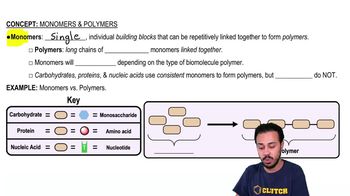
Monomers are the basic building blocks of larger molecules known as polymers. In the context of the question, glucose is a monomer that combines to form the polymer starch. Understanding this relationship is crucial for recognizing how smaller units can assemble into complex structures in biological systems.
Recommended video:
03:42
Monomers & Polymers

Biomolecules

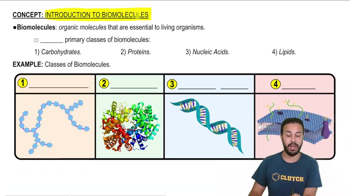
Biomolecules are organic molecules that are essential for life, including carbohydrates, proteins, lipids, and nucleic acids. Each type of biomolecule has specific functions and structures. The question compares glucose and starch, which are both carbohydrates, highlighting the relationship between simple sugars and their complex forms.
Recommended video:
01:22
Introduction to Biomolecules

Structural Relationships

Structural relationships in biology refer to how smaller units relate to larger structures. For example, just as glucose relates to starch, other biomolecules have similar relationships, such as amino acids to proteins. Recognizing these relationships helps in understanding the organization and function of biological macromolecules.
Recommended video:
Guided course
4:16
Structure of the Eyeball Example 1