Ch. 2 Basic Chemistry
Marieb - Essentials of Human Anatomy & Physiology 13th Edition
Marieb13th EditionEssentials of Human Anatomy & PhysiologyISBN: 9780135624340Not the one you use?Change textbook
Chapter 2, Problem 15

Define radioactivity. If an element has three isotopes, which of them (the lightest, the one with an intermediate mass, or the heaviest) is most likely to be a radioisotope, and why?

Verified step by step guidance
1
Radioactivity is the process by which unstable atomic nuclei lose energy by emitting radiation in the form of particles or electromagnetic waves. This occurs because the nucleus of the atom is not stable due to an imbalance in the number of protons and neutrons.
Isotopes are variants of a chemical element that have the same number of protons but different numbers of neutrons. This difference in neutron count affects the stability of the nucleus.
The likelihood of an isotope being a radioisotope depends on the neutron-to-proton ratio. A nucleus with too many or too few neutrons compared to protons is more likely to be unstable and radioactive.
Among the three isotopes (lightest, intermediate mass, and heaviest), the heaviest isotope is most likely to be a radioisotope. This is because heavier isotopes tend to have a higher neutron-to-proton ratio, which can lead to instability in the nucleus.
The instability arises because the strong nuclear force, which holds the nucleus together, becomes less effective at counteracting the repulsive forces between protons as the neutron count increases disproportionately. This makes heavier isotopes more prone to radioactive decay.

Verified video answer for a similar problem:

This video solution was recommended by our tutors as helpful for the problem above.
Video duration:
3m
Was this helpful?

Key Concepts

Here are the essential concepts you must grasp in order to answer the question correctly.

Radioactivity

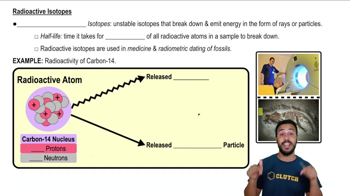
Radioactivity is the process by which unstable atomic nuclei lose energy by emitting radiation. This decay can occur in the form of alpha particles, beta particles, or gamma rays, leading to the transformation of the original element into a different element or isotope. The rate of decay is characterized by the half-life, which is the time required for half of the radioactive atoms in a sample to decay.
Recommended video:
03:27
Radioactive Isotopes

Isotopes

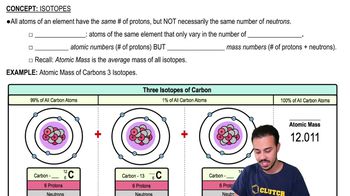
Isotopes are variants of a particular chemical element that have the same number of protons but different numbers of neutrons, resulting in different atomic masses. While some isotopes are stable, others are unstable and undergo radioactive decay. The stability of an isotope is influenced by the ratio of neutrons to protons in the nucleus, which affects its likelihood of being a radioisotope.
Recommended video:
06:50
Isotopes

Stability of Isotopes

The stability of isotopes is determined by the balance between the strong nuclear force, which holds protons and neutrons together, and the electromagnetic force, which causes repulsion between protons. Generally, lighter isotopes tend to be more stable, while heavier isotopes are more likely to be unstable and radioactive. Therefore, in a set of isotopes, the heaviest one is often the most likely to be a radioisotope due to its greater neutron-to-proton ratio and increased instability.
Recommended video:
06:50
Isotopes