Ch. 10 Blood
Marieb - Essentials of Human Anatomy & Physiology 13th Edition
Marieb13th EditionEssentials of Human Anatomy & PhysiologyISBN: 9780135624340Not the one you use?Change textbook
Chapter 10, Problem 23

A woman comes to the clinic complaining of fatigue, shortness of breath, and chills. Blood tests show anemia, and a bleeding ulcer is diagnosed. What type of anemia is this?

Verified step by step guidance
1
Step 1: Begin by understanding the symptoms presented by the patient. Fatigue, shortness of breath, and chills are common signs of anemia, which is a condition characterized by a reduced ability of the blood to carry oxygen due to a decrease in red blood cells or hemoglobin.
Step 2: Analyze the blood test results that confirm anemia. Anemia can be classified into different types based on its cause, such as iron deficiency anemia, pernicious anemia, or anemia due to chronic disease. In this case, the presence of a bleeding ulcer is a key clue.
Step 3: Recognize that a bleeding ulcer can lead to chronic blood loss. Chronic blood loss often results in iron deficiency anemia because the body loses iron along with the blood, and iron is essential for hemoglobin production.
Step 4: Consider the mechanism of iron deficiency anemia. When the body loses blood over time, it depletes its iron stores, leading to insufficient hemoglobin synthesis. This results in smaller and paler red blood cells, a condition known as microcytic hypochromic anemia.
Step 5: Conclude that the type of anemia associated with a bleeding ulcer is most likely iron deficiency anemia. This diagnosis is supported by the patient's symptoms, the blood test results, and the underlying cause of chronic blood loss from the ulcer.

Verified video answer for a similar problem:

This video solution was recommended by our tutors as helpful for the problem above.
Video duration:
3m
Was this helpful?

Key Concepts

Here are the essential concepts you must grasp in order to answer the question correctly.

Anemia

Anemia is a condition characterized by a deficiency in the number or quality of red blood cells, which impairs the blood's ability to carry oxygen. Symptoms often include fatigue, weakness, and shortness of breath. Anemia can result from various causes, including nutritional deficiencies, chronic diseases, or blood loss.
Recommended video:
7:11
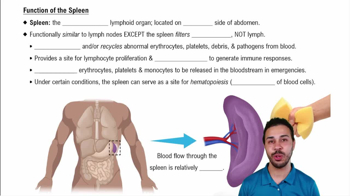
Function of the Spleen

Iron Deficiency Anemia

Iron deficiency anemia is the most common type of anemia, resulting from insufficient iron to produce hemoglobin, the protein in red blood cells that carries oxygen. It often occurs due to blood loss, poor diet, or malabsorption. In the context of a bleeding ulcer, the loss of blood can lead to this specific type of anemia.
Recommended video:
7:11
Function of the Spleen

Bleeding Ulcer

A bleeding ulcer is a sore on the lining of the stomach or the first part of the small intestine that has eroded into a blood vessel, causing bleeding. This condition can lead to significant blood loss, contributing to anemia. Symptoms may include abdominal pain, nausea, and signs of internal bleeding, such as fatigue and shortness of breath.
Recommended video:
Guided course
1:14
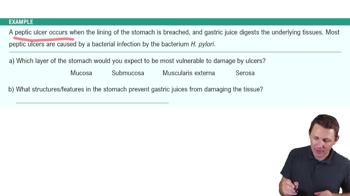
The Stomach Example 2
Related Practice
Textbook Question

If you had a high hematocrit, would you expect your hemoglobin determination to be high or low? Why?

2
views
Textbook Question

Lymphocytes continuously circulate through the body using blood and lymph as their transport vehicles. What is the importance of this recirculation behavior?

Textbook Question

A middle-aged college professor from Boston is in the Swiss Alps studying astronomy. He arrived two days ago and plans to stay the entire year. However, he notices that he is short of breath when he walks up steps and that he tires easily with any physical activity. His symptoms gradually disappear; after two months, he feels fine. Upon returning to the United States, he has a complete physical exam and is told that his erythrocyte count is higher than normal.

(a) Attempt to explain this finding.

(b) Will his RBC count remain at this higher-than-normal level? Why or why not?

3
views
Textbook Question

How can liver dysfunction cause bleeding disorders?

Textbook Question

A bone marrow biopsy of Mr. Lee, a man on long-term drug therapy, shows an abnormally high percentage of nonhematopoietic connective tissue. What condition does this indicate? If the symptoms are critical, what short-term and long-term treatments are indicated? Which treatment is he more likely to be given: infusion of whole blood or of packed red cells?

Textbook Question

Brittany, a healthy young woman, had a battery of tests during a physical for a new job. Her RBC count was at the higher end of the normal range at that time, but four weeks later it was substantially elevated beyond that. When asked if any circumstances had changed in her life, she admitted to taking up smoking. How might her new habit explain her higher RBC count?

1
views