Ch. 7 The Skeleton
Marieb - Human Anatomy & Physiology 11th Edition
Marieb, Hoehn11th EditionHuman Anatomy & PhysiologyISBN: 9780136874034Not the one you use?Change textbook
Chapter 7, Problem 4

Which vertebral curvatures are primary and which are secondary curvatures? Why are they called primary and secondary?

Verified step by step guidance
1
Step 1: Understand that vertebral curvatures refer to the natural curves in the spine that help it absorb shock and maintain balance.
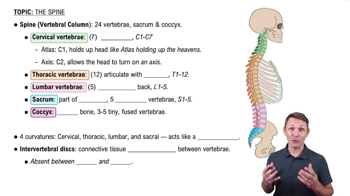
Step 2: Identify the primary curvatures, which are the thoracic and sacral curvatures. These are called primary because they are present at birth and reflect the original fetal curvature.
Step 3: Identify the secondary curvatures, which are the cervical and lumbar curvatures. These develop after birth as the child begins to lift their head (cervical) and later when they start to walk (lumbar).
Step 4: Explain that primary curvatures are called 'primary' because they are retained from the fetal position, forming a concave anterior curve, while secondary curvatures are called 'secondary' because they develop later to help with upright posture and balance, forming a convex anterior curve.
Step 5: Summarize that the distinction between primary and secondary curvatures is based on their time of development and their functional role in adapting the spine for bipedal posture.

Key Concepts

Here are the essential concepts you must grasp in order to answer the question correctly.

Primary Vertebral Curvatures

Primary curvatures are the spinal curves present at birth, including the thoracic and sacral regions. They are called primary because they develop during fetal life and maintain the original C-shaped curve of the spine.
Recommended video:
Guided course
6:29
Spine (Vertebral Column)

Secondary Vertebral Curvatures

Secondary curvatures develop after birth as the child grows and begins to hold up their head and walk. These include the cervical and lumbar curvatures, which form opposite curves to the primary ones, helping to balance the body and support upright posture.
Recommended video:
Guided course
6:29
Spine (Vertebral Column)

Reason for Classification as Primary and Secondary

The terms primary and secondary refer to the timing and function of the curvatures. Primary curvatures are retained from fetal development, while secondary curvatures arise postnatally to adapt the spine for weight-bearing and mobility, enhancing balance and flexibility.
Recommended video:
6:59
Primary and Secondary Response of Adaptive Immunity