Ch. 4 Tissue: The Living Fabric
Marieb - Human Anatomy & Physiology 11th Edition
Marieb, Hoehn11th EditionHuman Anatomy & PhysiologyISBN: 9780136874034Not the one you use?Change textbook
Chapter 4, Problem 11

Name four important functions of epithelial tissue and provide at least one example of a tissue that exemplifies each function.

Verified step by step guidance
1
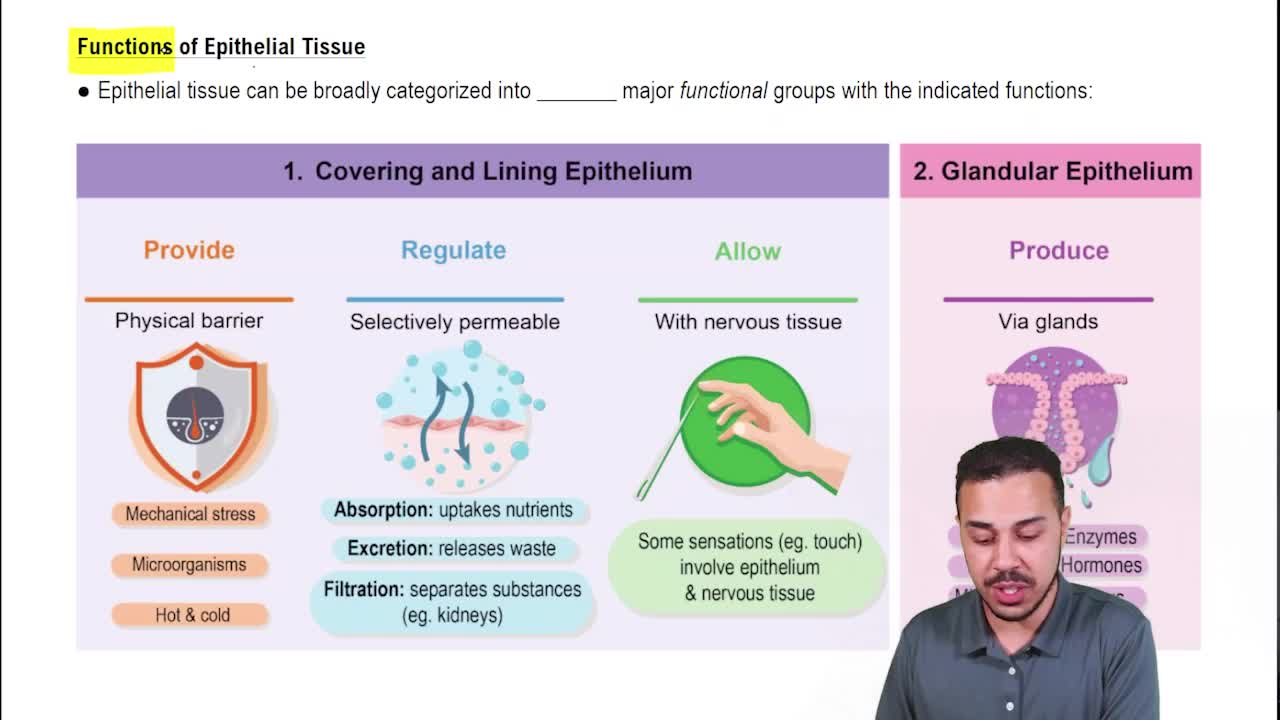
Identify the primary functions of epithelial tissue, which include protection, absorption, secretion, and filtration.
For the function of protection, explain that epithelial tissue acts as a barrier against mechanical injury, pathogens, and fluid loss. An example is the stratified squamous epithelium found in the skin's epidermis.
For absorption, describe how epithelial cells take in substances such as nutrients. An example is the simple columnar epithelium lining the small intestine, which absorbs nutrients from digested food.
For secretion, clarify that epithelial tissue forms glands that release substances like enzymes, hormones, or mucus. An example is the simple cuboidal epithelium in the glands of the pancreas that secretes digestive enzymes.
For filtration, explain that epithelial tissue allows selective passage of materials, such as in the kidneys. An example is the simple squamous epithelium in the glomeruli of the kidneys, which facilitates filtration of blood.

Verified video answer for a similar problem:

This video solution was recommended by our tutors as helpful for the problem above.
Video duration:
1m
Was this helpful?

Key Concepts

Here are the essential concepts you must grasp in order to answer the question correctly.

Functions of Epithelial Tissue

Epithelial tissue performs several key functions including protection, absorption, secretion, and sensation. These functions help maintain homeostasis by forming barriers, facilitating nutrient uptake, producing substances like enzymes or hormones, and detecting stimuli.
Recommended video:
Guided course
07:25
Functions of Epithelial Tissue

Types of Epithelial Tissue

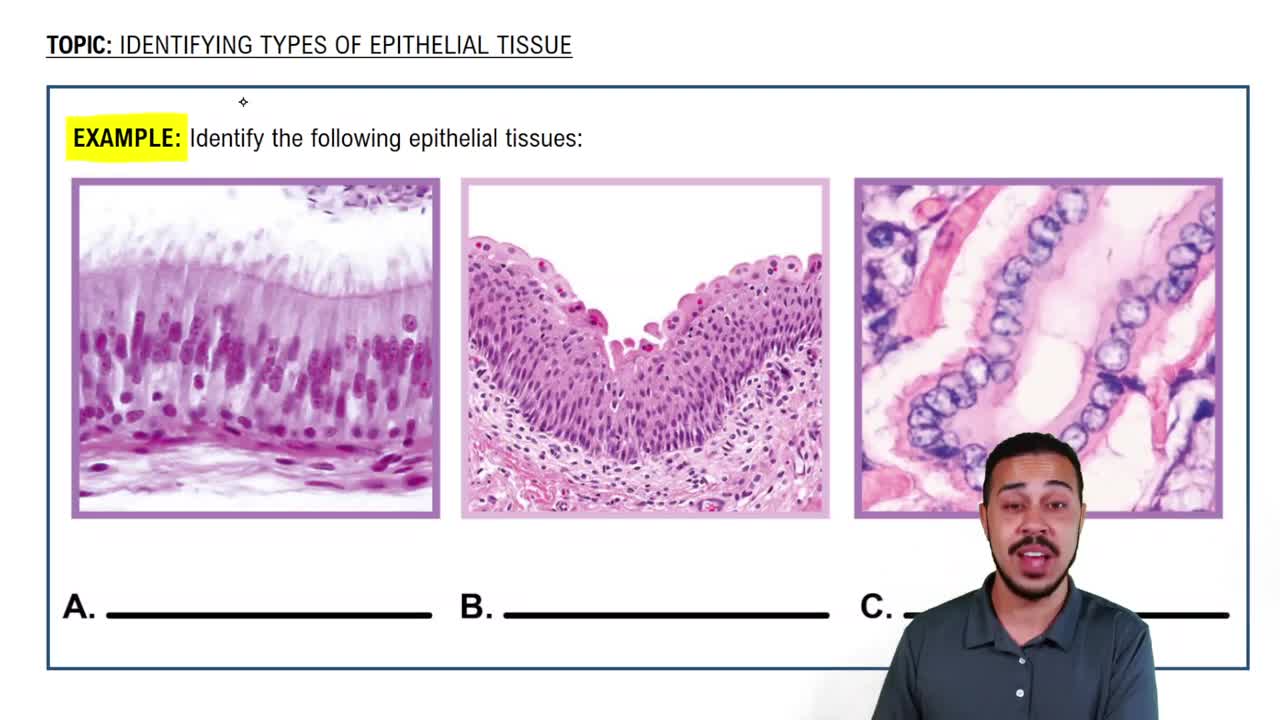
Epithelial tissues are classified based on cell shape and layering, such as simple squamous, stratified squamous, cuboidal, and columnar. Each type is specialized to perform specific functions, like simple squamous for diffusion or stratified squamous for protection.
Recommended video:
Guided course
07:25
Identifying Types of Epithelial Tissue Example 1

Examples of Epithelial Tissue Functions

Examples include the skin’s stratified squamous epithelium for protection, intestinal simple columnar epithelium for absorption, glandular epithelium for secretion, and sensory epithelium in the nose or tongue for sensation. These illustrate how structure relates to function.
Recommended video:
Guided course
07:25
Functions of Epithelial Tissue