Ch. 3 Cells: The Living Units
Marieb - Human Anatomy & Physiology 11th Edition
Marieb, Hoehn11th EditionHuman Anatomy & PhysiologyISBN: 9780136874034Not the one you use?Change textbook
Chapter 3, Problem 2

The major types of lipids found in the plasma membranes are (choose two):
a. Cholesterol
b. Triglycerides
c. Phospholipids
d. Fat-soluble vitamins

Verified step by step guidance
1
Step 1: Understand the composition of the plasma membrane. The plasma membrane primarily consists of a lipid bilayer that provides structural integrity and regulates the movement of substances in and out of the cell.
Step 2: Identify the major types of lipids typically found in the plasma membrane. These lipids contribute to membrane fluidity, stability, and functionality.
Step 3: Recognize that phospholipids are a major component of the plasma membrane. They form the bilayer structure with hydrophilic heads facing outward and hydrophobic tails facing inward.
Step 4: Understand that cholesterol is another key lipid in the plasma membrane. It is interspersed among phospholipids and helps modulate membrane fluidity and stability.
Step 5: Exclude triglycerides and fat-soluble vitamins as major plasma membrane lipids because triglycerides primarily serve as energy storage molecules, and fat-soluble vitamins are not structural components of the membrane.

Verified video answer for a similar problem:

This video solution was recommended by our tutors as helpful for the problem above.
Video duration:
2m
Was this helpful?

Key Concepts

Here are the essential concepts you must grasp in order to answer the question correctly.

Plasma Membrane Structure

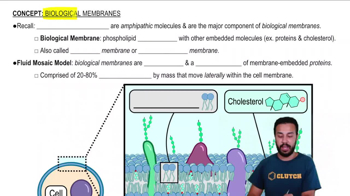
The plasma membrane is a biological barrier that separates the cell interior from the external environment. It is primarily composed of a lipid bilayer, which provides fluidity and selective permeability essential for cell function.
Recommended video:
06:49
Biological Membranes

Phospholipids in Membranes

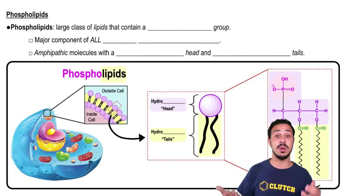
Phospholipids are the main lipid components of the plasma membrane, forming a bilayer with hydrophilic heads facing outward and hydrophobic tails inward. This arrangement creates a semi-permeable membrane critical for controlling substance movement.
Recommended video:
04:05
Phospholipids

Role of Cholesterol in Membranes

Cholesterol is a lipid molecule interspersed within the phospholipid bilayer that modulates membrane fluidity and stability. It prevents membranes from becoming too rigid or too permeable, maintaining optimal membrane function.
Recommended video:
06:49
Biological Membranes