Ch. 29 Heredity

Marieb, Hoehn11th EditionHuman Anatomy & PhysiologyISBN: 9780136874034
Not the one you use?Change textbookSelect a different textbook
Table of contents
- Ch. 1 The Human Body: An Orientation24
- Ch. 2 Chemistry Comes Alive25
- Ch. 3 Cells: The Living Units21
- Ch. 4 Tissue: The Living Fabric20
- Ch. 5 The Integumentary System11
- Ch. 6 Bones and Skeletal Tissues19
- Ch. 7 The Skeleton14
- Ch. 8 Joints7
- Ch. 9 Muscles and Muscle Tissue26
- Ch. 10 The Muscular System26
- Ch. 11 Fundamentals of the Nervous System and Nervous Tissue19
- Ch. 12 The Central Nervous System26
- Ch. 13 The Peripheral Nervous System and Reflex Activity32
- Ch. 14 The Autonomic Nervous System19
- Ch. 15 The Special Senses26
- Ch. 16 The Endocrine System23
- Ch. 17 Blood25
- Ch. 18 The Cardiovascular System: The Heart24
- Ch. 19 The Cardiovascular System: Blood Vessels27
- Ch. 20 The Lymphatic System and Lymphoid Organs and Tissues14
- Ch. 21 The Immune System: Innate and Adaptive Body Defenses27
- Ch. 22 The Respiratory System21
- Ch. 23 The Digestive System31
- Ch. 24 Nutrition, Metabolism, and Energy Balance26
- Ch. 25 The Urinary System26
- Ch. 26 Fluid, Electrolyte, and Acid-Base Balance24
- Ch. 27 The Reproductive System24
- Ch. 28 Pregnancy and Human Development25
- Ch. 29 Heredity11
Marieb, Hoehn11th EditionHuman Anatomy & PhysiologyISBN: 9780136874034Not the one you use?Change textbook

Chapter 29, Problem 11
A genetic counselor has been consulted by a couple that is concerned about a dominant form of syndactyly (fused fingers or toes) in the male partner, Paul. Paul has syndactyly, as do his three brothers. His mother, his maternal grandparents, and his paternal grandfather do not have syndactyly, but his father and paternal grandmother do. The counselor constructs a pedigree spanning three generations for Paul’s family. Draw this pedigree and show the phenotype and genotype for each person.
 Verified step by step guidance
1
Step 1: Understand the inheritance pattern. Since syndactyly is described as a dominant trait, individuals with at least one dominant allele (S) will show the phenotype. Those without the trait are homozygous recessive (ss).
Step 2: Assign genotypes based on phenotypes. Paul has syndactyly, so his genotype is either SS or Ss. His three brothers also have syndactyly, so they share the same genotype possibilities. Individuals without syndactyly are ss.
Step 3: Analyze the family members' phenotypes and infer genotypes. Paul's mother, maternal grandparents, and paternal grandfather do not have syndactyly, so their genotypes are ss. Paul's father and paternal grandmother have syndactyly, so they are either SS or Ss.
Step 4: Draw the pedigree chart with three generations. Use squares for males and circles for females. Shade the symbols for individuals with syndactyly and leave unshaded those without. Connect parents to children with vertical and horizontal lines.
Step 5: Label each individual with their phenotype (affected or unaffected) and assign the most likely genotype based on the inheritance pattern and family information, considering that dominant traits typically appear in every generation and that unaffected individuals are homozygous recessive.
Key Concepts
Here are the essential concepts you must grasp in order to answer the question correctly.
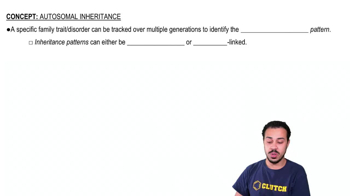
Autosomal Dominant Inheritance
Autosomal dominant inheritance means a single copy of the mutated gene on a non-sex chromosome causes the trait to be expressed. Affected individuals typically have one affected parent, and the trait appears in every generation. Both males and females are equally likely to be affected, and there is a 50% chance of passing the trait to offspring.
Recommended video:
Guided course
 01:02
01:02
Autosomal Inheritance
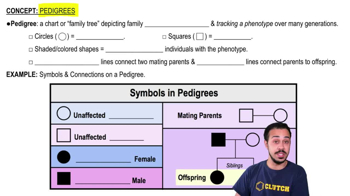
Pedigree Construction and Interpretation
A pedigree is a family tree diagram that shows the occurrence of traits across generations. It uses standardized symbols to represent individuals and their phenotypes, helping to track inheritance patterns. Understanding how to assign genotypes and phenotypes in a pedigree is essential for analyzing genetic risks.
Recommended video:
Guided course
 02:36
02:36Pedigrees
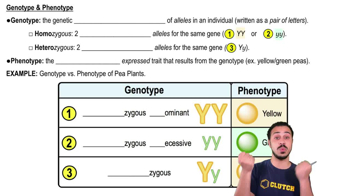
Genotype and Phenotype Correlation
Phenotype refers to the observable trait, while genotype is the genetic makeup underlying it. In dominant conditions, individuals with one or two copies of the dominant allele show the phenotype. Correctly deducing genotypes from phenotypes in family members is crucial for predicting inheritance and counseling.
Recommended video:
Guided course
 06:36
06:36Genotype & Phenotype
Related Practice