Ch. 27 The Reproductive System
Marieb - Human Anatomy & Physiology 11th Edition
Marieb, Hoehn11th EditionHuman Anatomy & PhysiologyISBN: 9780136874034Not the one you use?Change textbook
Chapter 27, Problem 1

The normal diploid number of human chromosomes is:
a. 48
b. 47
c. 46
d. 23
e. 24

Verified step by step guidance
1
Understand that the diploid number refers to the total number of chromosomes present in a typical somatic (body) cell, which includes two sets of chromosomes—one set inherited from each parent.
Recall that humans have 23 pairs of chromosomes, meaning each pair consists of two homologous chromosomes.
Calculate the total number of chromosomes by multiplying the number of pairs by 2: \(23 \times 2\).
Recognize that this total represents the diploid number, which is the standard chromosome count in human somatic cells.
Compare the calculated diploid number to the options provided to identify the correct answer.

Verified video answer for a similar problem:

This video solution was recommended by our tutors as helpful for the problem above.
Video duration:
1m
Was this helpful?

Key Concepts

Here are the essential concepts you must grasp in order to answer the question correctly.

Diploid Number

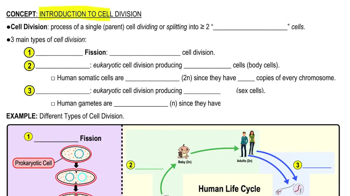
The diploid number refers to the total number of chromosomes present in a typical somatic cell of an organism, containing two sets—one from each parent. In humans, this number represents paired chromosomes, essential for maintaining genetic stability across generations.
Recommended video:
09:40
Introduction to Cell Division

Human Chromosome Count

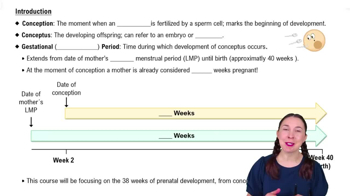
Humans normally have 46 chromosomes in their somatic cells, arranged in 23 pairs. This includes 22 pairs of autosomes and one pair of sex chromosomes, which determine biological sex. This count is fundamental to human genetics and cell biology.
Recommended video:
4:48
Introduction to Human Development

Haploid Number

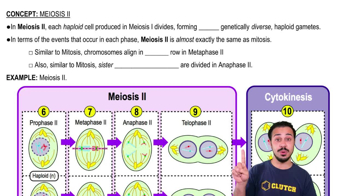
The haploid number is the number of chromosomes in gametes (sperm and egg cells), which is half the diploid number. For humans, the haploid number is 23, ensuring that upon fertilization, the diploid number of 46 is restored.
Recommended video:
6:17
Meiosis II