Ch. 25 The Urinary System
Marieb - Human Anatomy & Physiology 11th Edition
Marieb, Hoehn11th EditionHuman Anatomy & PhysiologyISBN: 9780136874034Not the one you use?Change textbook
Chapter 25, Problem 23

Mrs. Bigda, a 60-year-old woman, was brought to the hospital by the police after falling to the pavement. She is found to have alcoholic hepatitis. She is put on a salt- and protein-restricted diet and diuretics are prescribed to manage her ascites (accumulated fluid in the peritoneal cavity). How will diuretics reduce this excess fluid? Name and describe the mechanisms of action of three types of diuretics. Why is her diet salt-restricted?

Verified step by step guidance
1
Step 1: Understand the clinical context—Mrs. Bigda has ascites, which is the accumulation of excess fluid in the peritoneal cavity, often due to liver dysfunction such as alcoholic hepatitis. This fluid buildup is related to imbalances in fluid and electrolyte regulation, including sodium retention.
Step 2: Explain how diuretics reduce excess fluid—Diuretics promote the excretion of sodium and water by the kidneys, which decreases blood volume and reduces the hydrostatic pressure that pushes fluid into the peritoneal cavity. This helps mobilize and eliminate the ascitic fluid.
Step 3: Describe the mechanism of action of three types of diuretics: (a) Loop diuretics (e.g., furosemide) inhibit the Na\(\textsuperscript{+}\)-K\(\textsuperscript{+}\)-2Cl\(\textsuperscript{-}\) symporter in the thick ascending limb of the loop of Henle, causing significant sodium and water loss; (b) Thiazide diuretics inhibit the Na\(\textsuperscript{+}\)-Cl\(\textsuperscript{-}\) symporter in the distal convoluted tubule, leading to moderate sodium and water excretion; (c) Potassium-sparing diuretics (e.g., spironolactone) antagonize aldosterone receptors in the collecting duct, reducing sodium reabsorption and potassium excretion, which is especially useful in liver disease to prevent hypokalemia.
Step 4: Explain why the diet is salt-restricted—A salt-restricted diet limits sodium intake, which helps prevent further sodium and water retention by the kidneys. This reduces the formation of ascitic fluid and complements the action of diuretics in managing fluid overload.
Step 5: Summarize the integrated approach—Combining salt restriction with diuretics targets both the cause (sodium retention) and the symptom (fluid accumulation), improving the patient's condition by reducing ascites and preventing complications.

Verified video answer for a similar problem:

This video solution was recommended by our tutors as helpful for the problem above.
Video duration:
3m
Was this helpful?

Key Concepts

Here are the essential concepts you must grasp in order to answer the question correctly.

Mechanism of Diuretics in Reducing Ascites

Diuretics reduce excess fluid by increasing urine output, which decreases plasma volume and lowers hydrostatic pressure in blood vessels. This helps mobilize fluid accumulated in the peritoneal cavity (ascites) back into circulation for excretion, thereby reducing swelling and fluid buildup.
Recommended video:
3:02
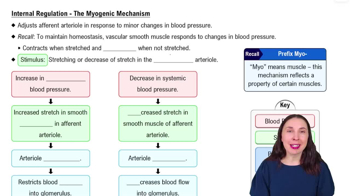
Internal Regulation - The Myogenic Mechanism

Types and Mechanisms of Diuretics

Three common diuretics include: (1) Spironolactone, an aldosterone antagonist that blocks sodium reabsorption in the distal tubules, promoting sodium and water excretion; (2) Furosemide, a loop diuretic that inhibits sodium-potassium-chloride co-transporters in the thick ascending limb of the loop of Henle, causing potent diuresis; (3) Thiazide diuretics, which inhibit sodium-chloride symporters in the distal convoluted tubule, leading to moderate sodium and water loss.
Recommended video:
3:00
Types-Of-Phosphorylation-C-2-V-1

Rationale for Salt-Restricted Diet in Ascites Management

A salt-restricted diet limits sodium intake, reducing water retention because sodium promotes fluid retention in the body. Lowering salt intake decreases extracellular fluid volume and helps prevent worsening of ascites by minimizing fluid accumulation in the peritoneal cavity.
Recommended video:
Guided course
02:51
Introduction to Connective Tissue Proper Example 2