Ch. 24 Nutrition, Metabolism, and Energy Balance
Marieb - Human Anatomy & Physiology 11th Edition
Marieb, Hoehn11th EditionHuman Anatomy & PhysiologyISBN: 9780136874034Not the one you use?Change textbook
Chapter 24, Problem 8

Which of the following is not a function of the liver?
a. Glycogenolysis and gluconeogenesis
b. Synthesis of cholesterol
c. Detoxification of alcohol and drugs
d. Synthesis of glucagon
e. Deamination of amino acids.

Verified step by step guidance
1
Step 1: Understand the question. The problem is asking which of the listed options is NOT a function of the liver. This means we need to identify the functions of the liver and determine which one does not belong.
Step 2: Review the functions of the liver. The liver is responsible for several key processes, including glycogenolysis (breaking down glycogen into glucose), gluconeogenesis (producing glucose from non-carbohydrate sources), cholesterol synthesis, detoxification of harmful substances like alcohol and drugs, and deamination (removal of the amino group from amino acids).
Step 3: Analyze each option. Go through each option and determine if it aligns with the known functions of the liver: a) Glycogenolysis and gluconeogenesis are liver functions. b) Synthesis of cholesterol is a liver function. c) Detoxification of alcohol and drugs is a liver function. d) Synthesis of glucagon is not a liver function; glucagon is synthesized by the pancreas. e) Deamination of amino acids is a liver function.
Step 4: Identify the correct answer. Based on the analysis, the option that does not describe a liver function is the synthesis of glucagon (option d).
Step 5: Conclude the reasoning. The liver does not synthesize glucagon; this hormone is produced by the alpha cells of the pancreas. Therefore, option d is the correct answer.

Verified video answer for a similar problem:

This video solution was recommended by our tutors as helpful for the problem above.
Video duration:
1m
Was this helpful?

Key Concepts

Here are the essential concepts you must grasp in order to answer the question correctly.

Liver Functions

The liver performs several critical functions, including metabolism, detoxification, and synthesis of important biomolecules. It regulates blood sugar levels through glycogenolysis and gluconeogenesis, synthesizes cholesterol, and detoxifies harmful substances like alcohol and drugs.
Recommended video:
Guided course
2:59
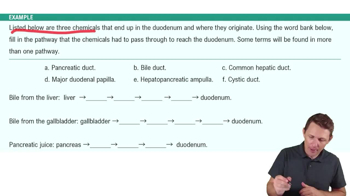
Duct System of the Liver, Gallbladder, and Pancreas Example 1

Glycogenolysis and Gluconeogenesis

Glycogenolysis is the process of breaking down glycogen into glucose, while gluconeogenesis is the synthesis of glucose from non-carbohydrate sources. Both processes are vital for maintaining blood glucose levels, especially during fasting or intense exercise.
Recommended video:
08:55
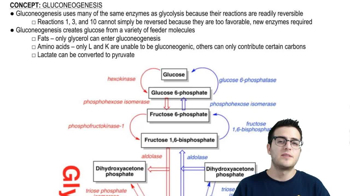
Gluconeogenesis 1

Hormonal Synthesis

The liver is involved in the synthesis of various hormones, but it does not produce glucagon. Glucagon is primarily synthesized by the alpha cells of the pancreas, which plays a crucial role in regulating blood glucose levels by promoting glycogen breakdown and gluconeogenesis.
Recommended video:
Guided course
13:06
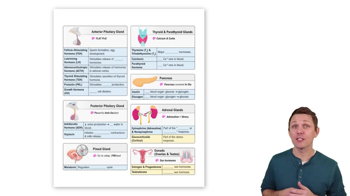
Review of Major Hormones