Ch. 21 The Immune System: Innate and Adaptive Body Defenses
Marieb - Human Anatomy & Physiology 11th Edition
Marieb, Hoehn11th EditionHuman Anatomy & PhysiologyISBN: 9780136874034Not the one you use?Change textbook
Chapter 21, Problem 12

Name the five antibody classes and describe where each is most likely to be found in the body.

Verified step by step guidance
1
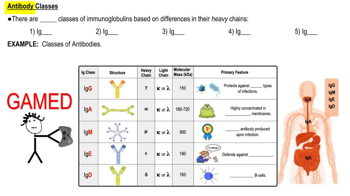
Identify the five main classes of antibodies (immunoglobulins), which are IgG, IgA, IgM, IgE, and IgD.
Describe IgG as the most abundant antibody in the blood and extracellular fluid, providing long-term immunity and capable of crossing the placenta to protect the fetus.
Explain that IgA is primarily found in mucosal areas such as the respiratory and gastrointestinal tracts, as well as in secretions like saliva, tears, and breast milk, where it protects mucous membranes.
Note that IgM is mainly found in the blood and lymphatic fluid and is the first antibody produced during an initial immune response.
Describe IgE as being associated with allergic reactions and parasitic infections, found bound to mast cells and basophils in tissues.
Mention that IgD is mostly found on the surface of immature B cells in lymphoid tissues and plays a role in initiating B cell activation.

Verified video answer for a similar problem:

This video solution was recommended by our tutors as helpful for the problem above.
Video duration:
2m
Was this helpful?

Key Concepts

Here are the essential concepts you must grasp in order to answer the question correctly.

Antibody Classes (Immunoglobulin Types)

Antibodies, or immunoglobulins, are proteins produced by B cells to identify and neutralize pathogens. There are five main classes: IgG, IgA, IgM, IgE, and IgD, each with distinct structures and immune functions.
Recommended video:
4:43
Classes of Antibodies

Distribution of Antibody Classes in the Body

Each antibody class is predominantly found in specific body locations. For example, IgG circulates in blood and extracellular fluid, IgA is abundant in mucosal areas like saliva and respiratory tract, IgM is mainly in blood plasma, IgE is associated with allergic responses in tissues, and IgD is mostly on B cell surfaces.
Recommended video:
4:43
Classes of Antibodies

Functional Roles of Antibody Classes

Different antibody classes serve unique immune roles: IgG provides long-term immunity, IgA protects mucosal surfaces, IgM is the first responder during infections, IgE mediates allergic reactions and defense against parasites, and IgD functions mainly as a receptor on immature B cells.
Recommended video:
4:43
Classes of Antibodies