Textbook Question
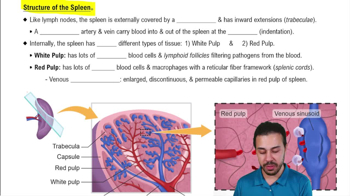
The lymphoid organ that functions primarily during youth and then begins to atrophy is:
a. Spleen
b. Thymus
c. Palatine tonsils
d. Bone marrow
2
views

 Marieb, Hoehn 11th EditionCh. 20 The Lymphatic System and Lymphoid Organs and TissuesProblem 11
 Verified step by step guidance
 10:32
10:32
 10:09
10:09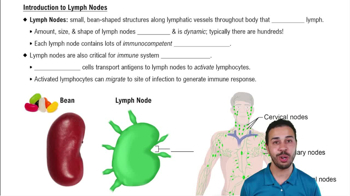 5:05
5:05The lymphoid organ that functions primarily during youth and then begins to atrophy is:
a. Spleen
b. Thymus
c. Palatine tonsils
d. Bone marrow
Collections of lymphoid tissue (MALT) that guard mucosal surfaces include all of the following except:
a. Appendix follicles
b. The tonsils
c. Peyer's patches
d. The thymus
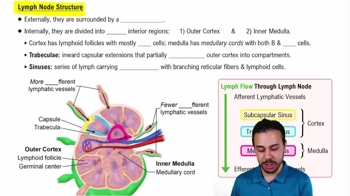
Which anatomical characteristic ensures that the flow of lymph through a lymph node is slow?
Why is this desirable?
Compare and contrast blood, interstitial fluid, and lymph.
A friend tells you that she has tender, swollen 'glands' along the left side of the front of her neck. You notice that she has a bandage on her left cheek that is not fully hiding a large infected cut there. Exactly what are her swollen 'glands,' and how did they become swollen?
Mrs. Jackson, a 59-year-old woman, has undergone a left radical mastectomy (removal of the left breast and left axillary lymph nodes and vessels). Her left arm is severely swollen and painful, and she is unable to raise it to more than shoulder height.
Explain her signs and symptoms.
Can she expect to have relief from these symptoms in time? How so?