Ch. 2 Chemistry Comes Alive
Marieb - Human Anatomy & Physiology 11th Edition
Marieb, Hoehn11th EditionHuman Anatomy & PhysiologyISBN: 9780136874034Not the one you use?Change textbook
Chapter 2, Problem 19

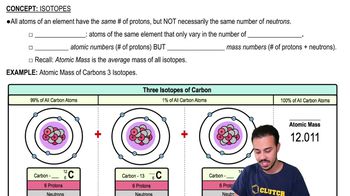
Consider the following information about three atoms: 12/6 C 13/6 C 14/6 C
a. How are they similar to one another?
b. How do they differ from one another?
c. What are the members of such a group of atoms called?
d. Using the planetary model, draw the atomic configuration of 12/6 C, showing the relative position and numbers of its subatomic particles

Verified step by step guidance
1
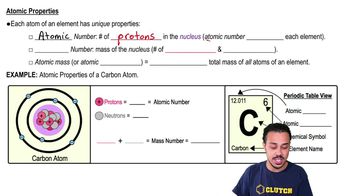
Identify the atomic number (number of protons) for each atom. Since all three atoms have the same atomic number 6, they all have 6 protons, which means they are all carbon atoms and share the same chemical properties.
Compare the mass numbers of the atoms: 12, 13, and 14. The mass number equals the sum of protons and neutrons. Since the number of protons is constant (6), the difference in mass number indicates a difference in the number of neutrons in each atom.
Explain that atoms with the same number of protons but different numbers of neutrons are called isotopes. Therefore, 12/6 C, 13/6 C, and 14/6 C are isotopes of carbon.
For the planetary model of 12/6 C, start by placing 6 protons and 6 neutrons in the nucleus at the center of the atom. Then, arrange 6 electrons in energy levels (shells) around the nucleus: 2 electrons in the first shell and 4 electrons in the second shell, showing their relative positions.
Label each part of the model clearly: nucleus containing protons and neutrons, and electron shells with electrons. This visual representation helps understand the atomic structure and how subatomic particles are organized.

Verified video answer for a similar problem:

This video solution was recommended by our tutors as helpful for the problem above.
Video duration:
2m
Was this helpful?

Key Concepts

Here are the essential concepts you must grasp in order to answer the question correctly.

Isotopes

Isotopes are atoms of the same element that have the same number of protons but different numbers of neutrons. This difference in neutron count results in varying atomic masses while maintaining chemical properties. For example, 12/6 C, 13/6 C, and 14/6 C are isotopes of carbon.
Recommended video:
06:50
Isotopes

Atomic Structure and Subatomic Particles

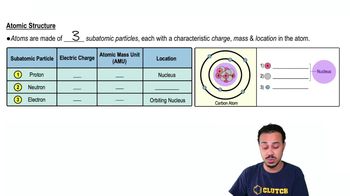
An atom consists of protons, neutrons, and electrons. Protons and neutrons form the nucleus, while electrons orbit around it. The number of protons defines the element, neutrons affect the isotope, and electrons determine chemical behavior. The planetary model depicts electrons orbiting the nucleus like planets around the sun.
Recommended video:
04:48
Atomic Structure

Planetary Model of the Atom

The planetary model represents the atom with a central nucleus containing protons and neutrons, and electrons moving in defined orbits around it. This model helps visualize the arrangement and relative positions of subatomic particles, aiding in understanding atomic configuration and electron distribution.
Recommended video:
07:43
Atomic Properties