Ch. 18 The Cardiovascular System: The Heart
Marieb - Human Anatomy & Physiology 11th Edition
Marieb, Hoehn11th EditionHuman Anatomy & PhysiologyISBN: 9780136874034Not the one you use?Change textbook
Chapter 18, Problem 12

Define cardiac cycle, and follow the events of one cycle.

Verified step by step guidance
1
Begin by defining the cardiac cycle as the sequence of mechanical and electrical events that repeat with every heartbeat, including the contraction and relaxation of the atria and ventricles.
Explain that the cardiac cycle consists of two main phases: systole (contraction) and diastole (relaxation), which occur in both the atria and ventricles but at different times.
Describe the first event: atrial systole, where the atria contract to push blood into the ventricles, completing ventricular filling.
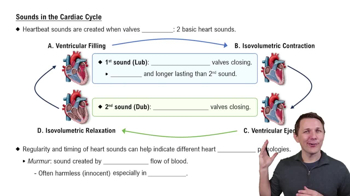
Next, outline ventricular systole, where the ventricles contract, causing the atrioventricular (AV) valves to close (producing the first heart sound) and the semilunar valves to open, allowing blood to be ejected into the arteries.
Finally, explain ventricular diastole, where the ventricles relax, the semilunar valves close (producing the second heart sound), and the AV valves open to allow passive filling of the ventricles, completing the cycle.

Verified video answer for a similar problem:

This video solution was recommended by our tutors as helpful for the problem above.
Video duration:
8m
Was this helpful?

Key Concepts

Here are the essential concepts you must grasp in order to answer the question correctly.

Cardiac Cycle

The cardiac cycle refers to the complete sequence of events in the heart from the beginning of one heartbeat to the start of the next. It includes phases of contraction and relaxation that enable blood to be pumped throughout the body.
Recommended video:
Guided course
9:44
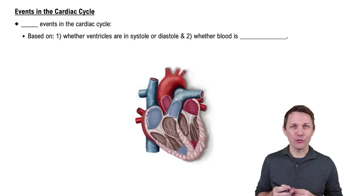
Events in the Cardiac Cycle

Phases of the Cardiac Cycle

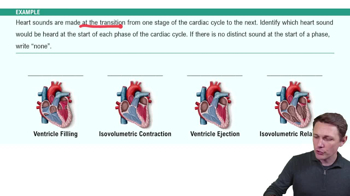
The cardiac cycle consists mainly of systole (contraction) and diastole (relaxation). During atrial systole, atria contract to fill ventricles; ventricular systole follows, pumping blood out; diastole allows chambers to relax and refill.
Recommended video:
Guided course
3:55
Cardiac Cycle Example 3

Heart Valve Function During the Cycle

Heart valves regulate blood flow direction during the cardiac cycle. The atrioventricular valves open during diastole to allow ventricular filling and close during systole to prevent backflow, while semilunar valves open during ventricular systole to eject blood.
Recommended video:
Guided course
7:54
Sounds in the Cardiac Cycle