Ch. 17 Blood
Marieb - Human Anatomy & Physiology 11th Edition
Marieb, Hoehn11th EditionHuman Anatomy & PhysiologyISBN: 9780136874034Not the one you use?Change textbook
Chapter 17, Problem 26

A reticulocyte count indicated that 5% of Tyler's red blood cells were reticulocytes. His blood test also indicated he had polycythemia and a hematocrit of 65%. Explain the connection between these three facts.

Verified step by step guidance
1
Step 1: Understand the terms involved. A reticulocyte is an immature red blood cell (RBC) recently released from the bone marrow. The reticulocyte count indicates the percentage of these young RBCs in the bloodstream, reflecting bone marrow activity.
Step 2: Recognize that a normal reticulocyte count typically ranges from about 0.5% to 2.5%. A count of 5% suggests an increased production of RBCs by the bone marrow, often in response to a need for more oxygen-carrying cells.
Step 3: Polycythemia is a condition characterized by an abnormally high concentration of red blood cells in the blood. This is consistent with the hematocrit value, which measures the percentage of blood volume occupied by RBCs. A hematocrit of 65% is significantly elevated (normal is roughly 40-50%), confirming polycythemia.
Step 4: Connect the facts: The elevated reticulocyte count indicates that Tyler's bone marrow is producing and releasing more RBCs, which leads to an increased number of circulating RBCs, causing polycythemia and a high hematocrit.
Step 5: Summarize the physiological relationship: Tyler's body is likely responding to a stimulus (such as hypoxia or another cause) by increasing erythropoiesis, resulting in more reticulocytes entering the bloodstream, which raises the total RBC count and hematocrit, manifesting as polycythemia.

Verified video answer for a similar problem:

This video solution was recommended by our tutors as helpful for the problem above.
Video duration:
2m
Was this helpful?

Key Concepts

Here are the essential concepts you must grasp in order to answer the question correctly.

Reticulocyte Count

Reticulocytes are immature red blood cells recently released from the bone marrow. The reticulocyte count measures the percentage of these cells in the blood, indicating the rate of red blood cell production. A higher count suggests increased bone marrow activity, often in response to anemia or blood loss.
Recommended video:

Polycythemia

Polycythemia is a condition characterized by an abnormally high concentration of red blood cells in the blood. This increases blood viscosity and hematocrit levels, which can lead to complications like clotting. It can be primary (due to bone marrow disorders) or secondary (due to increased erythropoietin from hypoxia).

Hematocrit

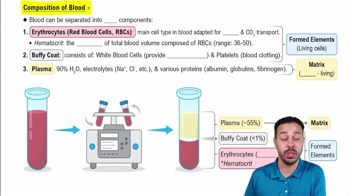
Hematocrit is the percentage of blood volume occupied by red blood cells. A normal range is about 40-50%, so a hematocrit of 65% indicates a high red blood cell concentration, consistent with polycythemia. It reflects the oxygen-carrying capacity and blood viscosity.
Recommended video:
7:49
Composition of Blood