Describe the anatomical relationship of the white and gray rami communicantes to the spinal nerve, and indicate the kind of fibers found in each ramus type.
Ch. 14 The Autonomic Nervous System

Marieb, Hoehn11th EditionHuman Anatomy & PhysiologyISBN: 9780136874034Not the one you use?Change textbook
Chapter 14, Problem 10
Which of the effects listed in response to question 9 would be reversed by parasympathetic activity?
Verified step by step guidance1
Identify the effects listed in response to question 9. These effects are likely related to sympathetic activity, as the parasympathetic system typically counteracts sympathetic responses.
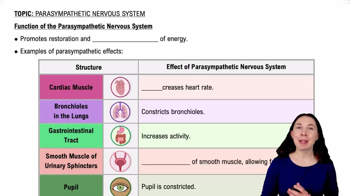
Understand the general roles of the parasympathetic nervous system. It is responsible for 'rest and digest' functions, which include decreasing heart rate, promoting digestion, and conserving energy.
Compare the effects listed in question 9 to the typical actions of the parasympathetic system. For example, if sympathetic activity increases heart rate, parasympathetic activity would decrease it.
Determine which specific effects from question 9 align with parasympathetic reversal. For instance, effects like pupil dilation (sympathetic) would be reversed by pupil constriction (parasympathetic).
Conclude by matching each sympathetic effect from question 9 with its corresponding parasympathetic reversal, ensuring a clear understanding of how the two systems balance each other.

Verified video answer for a similar problem:
This video solution was recommended by our tutors as helpful for the problem above.
Video duration:
2mWas this helpful?
Key Concepts
Here are the essential concepts you must grasp in order to answer the question correctly.
Parasympathetic Nervous System
The parasympathetic nervous system is a component of the autonomic nervous system responsible for promoting 'rest and digest' functions. It counteracts the 'fight or flight' responses of the sympathetic nervous system, leading to decreased heart rate, increased digestive activity, and relaxation of muscles. Understanding its role is crucial for identifying which physiological effects it can reverse.
Recommended video:
Function of the Parasympathetic Nervous System
Sympathetic Nervous System Effects
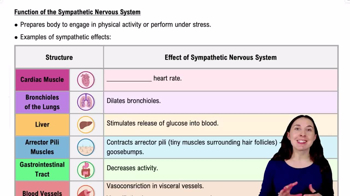
The sympathetic nervous system prepares the body for stressful or emergency situations, often referred to as the 'fight or flight' response. This includes increased heart rate, dilated pupils, and inhibited digestion. Recognizing these effects is essential to determine which of them can be reversed by parasympathetic activity.
Recommended video:
Function of the Sympathetic Nervous System
Homeostasis
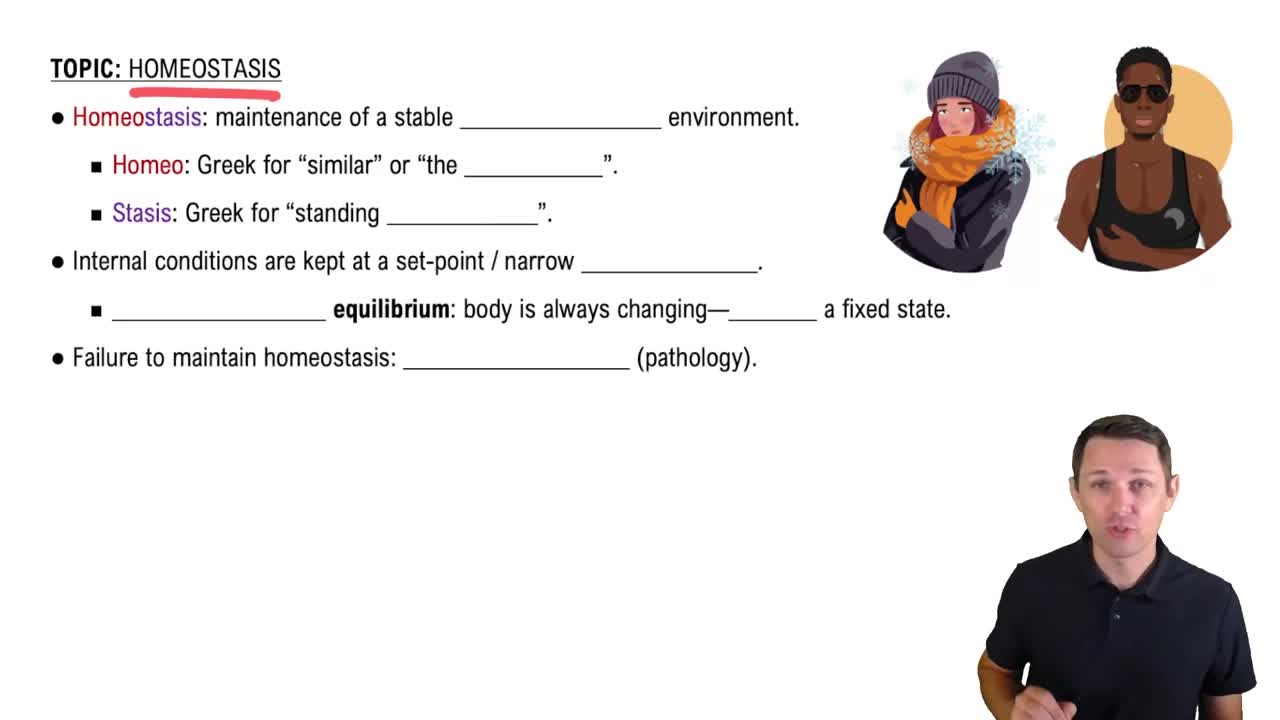
Homeostasis refers to the body's ability to maintain stable internal conditions despite external changes. The balance between the sympathetic and parasympathetic nervous systems is vital for homeostasis, as they regulate bodily functions in response to stress and relaxation. Understanding homeostasis helps in identifying how parasympathetic activity restores balance by reversing sympathetic effects.
Recommended video:
Guided course
Introduction to Homeostasis
Related Practice
Textbook Question
1
views
Textbook Question
Describe the importance of the hypothalamus in controlling the autonomic nervous system.
2
views
Textbook Question
Describe the meaning and importance of sympathetic tone and parasympathetic tone.
5
views
Textbook Question
A reflex that causes reciprocal activation of the antagonist muscle is the
a. Crossed-extensor
b. Flexor
c. Tendon
d. Muscle stretch
2
views
Textbook Question
Indicate the results of sympathetic activation of the following structures: sweat glands, eye pupils, adrenal medullae, heart, bronchioles of the lungs, liver, blood vessels of vigorously working skeletal muscles, blood vessels of digestive viscera, salivary glands.
5
views
Textbook Question
Briefly explain why the following terms are sometimes used to refer to the autonomic nervous system: involuntary nervous system and emotional-visceral system.