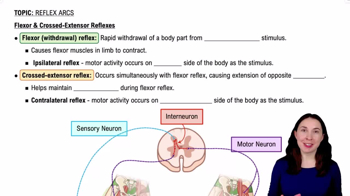
Understand that the flexor reflex is a protective, involuntary response that causes the withdrawal of a limb from a painful stimulus, helping to prevent injury.
Recognize that homeostasis refers to the body's ability to maintain a stable internal environment, including the regulation of reflexes to protect tissues.
Identify that the 'homeostatic value' of the flexor reflex is its role in maintaining tissue integrity by rapidly removing the body part from harmful stimuli, thus preventing damage.
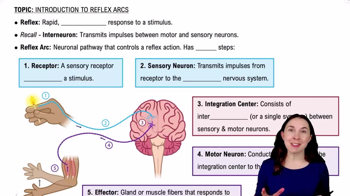
Consider how the reflex arc involved in the flexor reflex integrates sensory input (pain receptors) and motor output (muscle contraction) to achieve this protective effect.
Summarize that the homeostatic value of the flexor reflex lies in its function to preserve the body's structural integrity and promote survival by minimizing injury.
Verified video answer for a similar problem:
This video solution was recommended by our tutors as helpful for the problem above.
Video duration:
5m
Play a video:
0 Comments
Key Concepts
Here are the essential concepts you must grasp in order to answer the question correctly.
Flexor Reflex
The flexor reflex is a protective, involuntary response that causes the contraction of flexor muscles to withdraw a limb from a harmful stimulus. It is a type of spinal reflex that helps prevent injury by quickly removing the body part from danger.
Homeostasis refers to the body's ability to maintain stable internal conditions. In reflexes, homeostatic value means how the reflex contributes to maintaining bodily integrity and balance by responding appropriately to stimuli to protect tissues and support survival.
Reflex arcs are neural circuits that mediate reflex actions, involving sensory neurons, interneurons, and motor neurons. Understanding these pathways is essential to grasp how flexor reflexes are initiated and controlled to produce rapid, coordinated muscle responses.

 Marieb, Hoehn 11th Edition
 Verified step by step guidance
 2:42
2:42