
Ch. 13 The Peripheral Nervous System and Reflex Activity
Marieb - Human Anatomy & Physiology 11th Edition
Marieb, Hoehn11th EditionHuman Anatomy & PhysiologyISBN: 9780136874034Not the one you use?Change textbook
Chapter 13, Problem 2

Proprioceptors include all of the following except
a. Muscle spindles
b. Tendon organs
c. Epithelial tactile complexes
d. Joint kinesthetic receptors

Verified step by step guidance
1
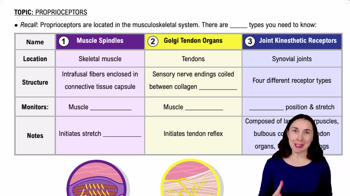
Step 1: Understand the definition of proprioceptors. Proprioceptors are sensory receptors located in muscles, tendons, and joints that provide information about body position, movement, and muscle tension.
Step 2: Identify the types of proprioceptors listed in the options. Muscle spindles detect changes in muscle length, tendon organs monitor tension in tendons, and joint kinesthetic receptors sense joint position and movement.
Step 3: Recognize that epithelial tactile complexes are not proprioceptors. Instead, they are mechanoreceptors found in the skin that detect touch and pressure, making them part of the somatosensory system but not involved in proprioception.
Step 4: Compare each option to the definition of proprioceptors to determine which one does not fit the category.
Step 5: Conclude that the correct answer is the option that is not a proprioceptor, based on the understanding of their functions and locations.

Verified video answer for a similar problem:

This video solution was recommended by our tutors as helpful for the problem above.
Video duration:
1m
Was this helpful?

Key Concepts

Here are the essential concepts you must grasp in order to answer the question correctly.

Proprioceptors

Proprioceptors are sensory receptors located in muscles, tendons, and joints that provide information about body position, movement, and muscle tension. They help maintain balance and coordinate movements by detecting changes in muscle length and tension.
Recommended video:
3:52
Proprioceptors

Muscle Spindles and Tendon Organs

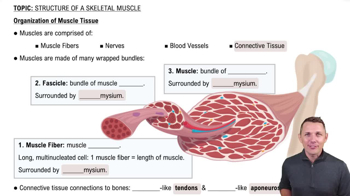
Muscle spindles detect changes in muscle length and trigger reflexes to maintain muscle tone, while tendon organs monitor tension in tendons to prevent muscle damage. Both are key types of proprioceptors involved in sensing body position and movement.
Recommended video:
Guided course
7:12
Organization of Muscle Tissue

Epithelial Tactile Complexes

Epithelial tactile complexes, also known as Merkel discs, are mechanoreceptors found in the skin that detect light touch and pressure. Unlike proprioceptors, they are involved in tactile sensation rather than sensing body position or movement.
Recommended video:
2:31
Major Histocompatibility Complexes