Ch. 9 Muscles and Muscle Tissue
Hoehn - Marieb Human Anatomy & Physiology, 12th edition
Hoehn, Haynes, Abbott12th EditionMarieb Human Anatomy & PhysiologyISBN: 9780138242732Not the one you use?Change textbook
Chapter 9, Problem 9

During muscle contraction, ATP is provided by:
a. a coupled reaction of creatine phosphate with ADP
b. aerobic respiration of glucose, and
c. anaerobic glycolysis.
______ (1) Which provides ATP fastest?
______  (2) Which does (do) not require that oxygen be available?
______  (3) Which provides the highest yield of ATP per glucose molecule?
______  (4) Which results in the formation of lactic acid?
______  (5) Which has carbon dioxide and water products?
______  (6) Which is most important in endurance sports?

Verified step by step guidance
1
Step 1: Understand the three ATP production methods mentioned: (a) creatine phosphate coupled with ADP, (b) aerobic respiration of glucose, and (c) anaerobic glycolysis. Each has distinct characteristics in speed, oxygen requirement, ATP yield, and byproducts.
Step 2: For question (1), identify which method provides ATP the fastest. Consider that creatine phosphate donates a phosphate group directly to ADP, which is a very rapid process compared to the others.
Step 3: For question (2), determine which methods do not require oxygen. Recall that aerobic respiration requires oxygen, while anaerobic glycolysis and creatine phosphate reactions do not.
Step 4: For question (3), analyze which method yields the most ATP per glucose molecule. Aerobic respiration fully oxidizes glucose, producing more ATP than anaerobic glycolysis, which partially breaks down glucose.
Step 5: For questions (4), (5), and (6), link the byproducts and typical usage scenarios: anaerobic glycolysis produces lactic acid, aerobic respiration produces carbon dioxide and water, and endurance sports rely mainly on aerobic respiration for sustained energy.

Verified video answer for a similar problem:

This video solution was recommended by our tutors as helpful for the problem above.
Video duration:
3m
Was this helpful?

Key Concepts

Here are the essential concepts you must grasp in order to answer the question correctly.

ATP Production Pathways in Muscle Contraction

Muscle cells generate ATP through three main pathways: creatine phosphate reaction, aerobic respiration, and anaerobic glycolysis. Creatine phosphate rapidly donates a phosphate group to ADP to form ATP, providing immediate energy. Aerobic respiration uses oxygen to fully oxidize glucose, producing a large amount of ATP. Anaerobic glycolysis breaks down glucose without oxygen, producing less ATP and lactic acid.
Recommended video:
Guided course
4:53
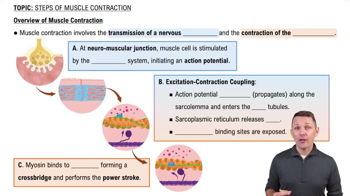
Overview of Muscle Contraction

Oxygen Dependence in Energy Metabolism

Aerobic respiration requires oxygen to efficiently produce ATP by oxidizing glucose into carbon dioxide and water. In contrast, anaerobic glycolysis and the creatine phosphate system do not require oxygen, allowing muscles to generate ATP quickly during oxygen-limited conditions, such as intense or short bursts of activity.
Recommended video:
02:17
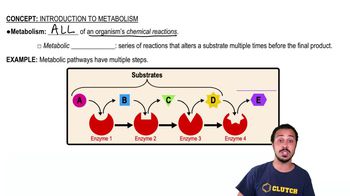
Introduction to Metabolism

ATP Yield and Byproducts of Metabolic Pathways

Aerobic respiration yields the highest ATP per glucose molecule (about 36-38 ATP) and produces carbon dioxide and water as byproducts. Anaerobic glycolysis yields only 2 ATP per glucose and produces lactic acid, which can cause muscle fatigue. The creatine phosphate system provides immediate ATP but does not involve glucose metabolism or produce byproducts.
Recommended video:
02:17
Introduction to Metabolism