


Ch. 8 Joints
Hoehn - Marieb Human Anatomy & Physiology, 12th edition
Hoehn, Haynes, Abbott12th EditionMarieb Human Anatomy & PhysiologyISBN: 9780138242732Not the one you use?Change textbook
Chapter 8, Problem 4

Factors that influence the stability of a synovial joint include
a. Shape of articular surfaces
b. Presence of strong reinforcing ligaments
c. Tone of surrounding muscles
d. All of these

Verified step by step guidance
1
Understand that the stability of a synovial joint depends on multiple anatomical and physiological factors working together to maintain joint integrity and prevent dislocation.
Consider the shape of the articular surfaces: joints with deeper or more congruent surfaces tend to be more stable because the bones fit together better, limiting unwanted movement.
Recognize the role of strong reinforcing ligaments: these connective tissues connect bones and provide passive stability by restricting excessive or abnormal joint movements.
Acknowledge the importance of muscle tone around the joint: muscles that are taut or active help stabilize the joint dynamically by supporting and controlling joint position during movement.
Conclude that since all these factors contribute to joint stability, the correct understanding is that the stability of a synovial joint is influenced by the shape of articular surfaces, the presence of strong reinforcing ligaments, and the tone of surrounding muscles.

Verified video answer for a similar problem:

This video solution was recommended by our tutors as helpful for the problem above.
Video duration:
2m
Was this helpful?

Key Concepts

Here are the essential concepts you must grasp in order to answer the question correctly.

Shape of Articular Surfaces

The shape of the bones forming a synovial joint affects how well they fit together, influencing joint stability. For example, a ball-and-socket joint like the hip has a deep socket that provides more stability compared to a shallow socket.
Recommended video:
4:05
Cell Surface Receptors

Reinforcing Ligaments

Ligaments are strong bands of connective tissue that connect bones and support joints. Their presence and strength help prevent excessive or abnormal movements, thereby enhancing joint stability.
Recommended video:
2:15
Structural Class: Synovial Joints Example 1

Muscle Tone Around the Joint

Muscle tone refers to the continuous and passive partial contraction of muscles surrounding a joint. This tone helps maintain joint alignment and stability by providing dynamic support during movement.
Recommended video:
05:39
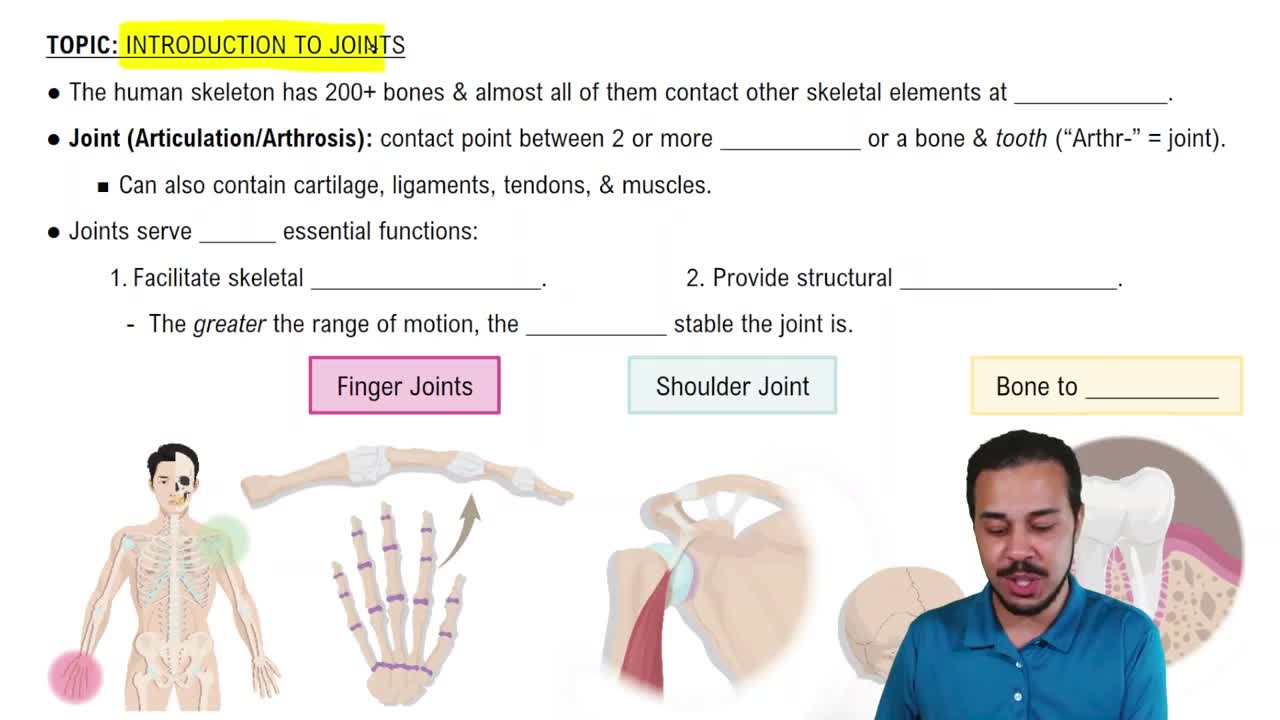
Introduction to Joints