Ch. 29 Heredity
Hoehn, Haynes, Abbott12th EditionMarieb Human Anatomy & PhysiologyISBN: 9780138242732
Not the one you use?Change textbookSelect a different textbook
Table of contents
- Ch. 1 The Human Body: An Orientation25
- Ch. 2 Chemistry Comes Alive24
- Ch. 3 Cells: The Living Units24
- Ch. 4 Tissue: The Living Fabric19
- Ch. 5 The Integumentary System12
- Ch. 6 Bones and Skeletal Tissues19
- Ch. 7 The Skeleton14
- Ch. 8 Joints7
- Ch. 9 Muscles and Muscle Tissue26
- Ch. 10 The Muscular System25
- Ch. 11 Fundamentals of the Nervous System and Nervous Tissue23
- Ch. 12 The Central Nervous System25
- Ch. 13 The Peripheral Nervous System and Reflex Activity30
- Ch. 14 The Autonomic Nervous System16
- Ch. 15 The Special Senses26
- Ch. 16 The Endocrine System26
- Ch. 17 Blood27
- Ch. 18 The Cardiovascular System: The Heart25
- Ch. 19 The Cardiovascular System: Blood Vessels27
- Ch. 20 The Lymphatic System and Lymphoid Organs and Tissues16
- Ch. 21 The Immune System: Innate and Adaptive Body Defenses27
- Ch. 22 The Respiratory System21
- Ch. 23 The Digestive System31
- Ch. 24 Nutrition, Metabolism, and Energy Balance26
- Ch. 25 The Urinary System26
- Ch. 26 Fluid, Electrolyte, and Acid-Base Balance24
- Ch. 27 The Reproductive System24
- Ch. 28 Pregnancy and Human Development25
- Ch. 29 Heredity11
Hoehn, Haynes, Abbott12th EditionMarieb Human Anatomy & PhysiologyISBN: 9780138242732Not the one you use?Change textbook

Chapter 29, Problem 3
Describe the important mechanisms that lead to genetic variations in gametes.
 Verified step by step guidance
1
Understand that genetic variation in gametes is crucial for diversity in offspring and occurs primarily through processes during meiosis and fertilization.
Explain the role of independent assortment during meiosis I, where homologous chromosome pairs are separated randomly, leading to different combinations of maternal and paternal chromosomes in gametes.
Describe crossing over (or recombination) during prophase I of meiosis, where homologous chromosomes exchange segments of DNA, creating new allele combinations on each chromosome.
Mention the random fertilization process, where any sperm can fuse with any egg, further increasing genetic variation by combining different sets of chromosomes from two parents.
Summarize that these mechanisms—independent assortment, crossing over, and random fertilization—work together to produce genetically unique gametes, contributing to the genetic diversity of a population.
Key Concepts
Here are the essential concepts you must grasp in order to answer the question correctly.
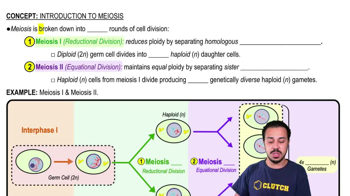
Meiosis
Meiosis is a specialized type of cell division that reduces the chromosome number by half, producing haploid gametes. It involves two rounds of division and introduces genetic variation through processes like crossing over and independent assortment.
Recommended video:
Guided course
 4:49
4:49
Meiosis I & Meiosis II
Crossing Over
Crossing over occurs during prophase I of meiosis when homologous chromosomes exchange segments of DNA. This recombination creates new allele combinations, increasing genetic diversity in the resulting gametes.
Recommended video:
 2:42
2:42Flexor & Crossed-Extensor Reflexes
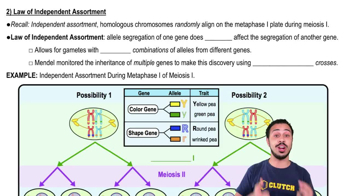
Independent Assortment
Independent assortment refers to the random distribution of maternal and paternal chromosomes into gametes during metaphase I of meiosis. This randomness ensures that each gamete has a unique set of chromosomes, contributing to genetic variation.
Recommended video:
Guided course
 06:44
06:44Law of Independent Assortment
Related Practice