Ch. 28 Pregnancy and Human Development

Hoehn, Haynes, Abbott12th EditionMarieb Human Anatomy & PhysiologyISBN: 9780138242732
Not the one you use?Change textbookSelect a different textbook
Table of contents
- Ch. 1 The Human Body: An Orientation25
- Ch. 2 Chemistry Comes Alive24
- Ch. 3 Cells: The Living Units24
- Ch. 4 Tissue: The Living Fabric19
- Ch. 5 The Integumentary System12
- Ch. 6 Bones and Skeletal Tissues19
- Ch. 7 The Skeleton14
- Ch. 8 Joints7
- Ch. 9 Muscles and Muscle Tissue26
- Ch. 10 The Muscular System25
- Ch. 11 Fundamentals of the Nervous System and Nervous Tissue23
- Ch. 12 The Central Nervous System25
- Ch. 13 The Peripheral Nervous System and Reflex Activity30
- Ch. 14 The Autonomic Nervous System16
- Ch. 15 The Special Senses26
- Ch. 16 The Endocrine System26
- Ch. 17 Blood27
- Ch. 18 The Cardiovascular System: The Heart25
- Ch. 19 The Cardiovascular System: Blood Vessels27
- Ch. 20 The Lymphatic System and Lymphoid Organs and Tissues16
- Ch. 21 The Immune System: Innate and Adaptive Body Defenses27
- Ch. 22 The Respiratory System21
- Ch. 23 The Digestive System31
- Ch. 24 Nutrition, Metabolism, and Energy Balance26
- Ch. 25 The Urinary System26
- Ch. 26 Fluid, Electrolyte, and Acid-Base Balance24
- Ch. 27 The Reproductive System24
- Ch. 28 Pregnancy and Human Development25
- Ch. 29 Heredity11
Hoehn, Haynes, Abbott12th EditionMarieb Human Anatomy & PhysiologyISBN: 9780138242732Not the one you use?Change textbook

Chapter 28, Problem 19
Explain how the flat embryonic disc takes on the cylindrical shape of a tadpole.
 Verified step by step guidance
1
Begin by understanding that the flat embryonic disc undergoes a process called embryonic folding, which transforms it into a three-dimensional, cylindrical shape resembling a tadpole.
Recognize that this folding occurs in two main planes: the longitudinal (head-to-tail) folding and the transverse (side-to-side) folding.
In longitudinal folding, the embryonic disc bends forward and downward, forming the head and tail folds, which help create the future head and tail regions of the embryo.
In transverse folding, the sides of the disc curve ventrally (toward the front), enclosing part of the yolk and forming the cylindrical body shape; this also helps establish the body wall and gut tube.
Together, these coordinated foldings convert the flat disc into a three-dimensional, cylindrical embryo with a distinct head, tail, and body, resembling a tadpole in shape.
Key Concepts
Here are the essential concepts you must grasp in order to answer the question correctly.
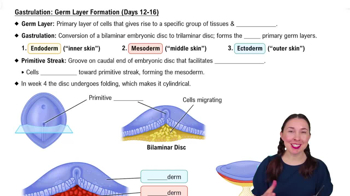
Gastrulation
Gastrulation is a critical embryonic process where the flat embryonic disc reorganizes into a multilayered structure, forming the three germ layers: ectoderm, mesoderm, and endoderm. This movement initiates the transformation from a flat disc to a more complex shape, setting the foundation for the body plan.
Recommended video:
 3:54
3:54
Gastrulation: Germ Layer Formation (Days 12-16)
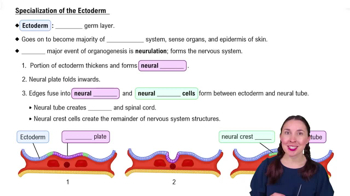
Neurulation
Neurulation follows gastrulation and involves the formation of the neural tube from the ectoderm. This process causes the embryonic disc to fold and elongate, contributing to the cylindrical, tadpole-like shape by creating the early nervous system and defining the body axis.
Recommended video:
 3:07
3:07Specialization of the Ectoderm
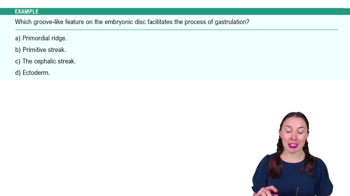
Embryonic Folding
Embryonic folding is the morphological change where the flat disc bends both longitudinally and transversely, converting it into a three-dimensional cylindrical shape. This folding encloses the yolk and forms the basic body shape resembling a tadpole, establishing the head, tail, and body regions.
Recommended video:
 0:27
0:27Embryonic Development (Weeks 3-8) Example 1
Related Practice