
For each of the following sets of blood values, name the acid-base imbalance (acidosis or alkalosis), determine its cause (metabolic or respiratory), decide whether the condition is being compensated, and cite at least one possible cause of the imbalance. Problem 1: pH 7.63; Pco₂ 19 mm Hg; Hco₃⁻ 19.5 mEq/L Problem 2: pH 7.22; Pco₂ 30 mm Hg; Hco₃⁻ 12.0 mEq/L
Hoehn, Haynes, Abbott 12th Edition
Ch. 26 Fluid, Electrolyte, and Acid-Base Balance
Problem 20Mr. Jessup, a 55-year-old man, is operated on for a cerebral tumor. About a month later, he appears at his physician's office complaining of excessive thirst. He claims to have been drinking about 20 liters of water daily for the past week and says he has been voiding nearly continuously. A urine sample is collected and its specific gravity is reported as 1.001.
What is your diagnosis of Mr. Jessup's problem?
What connection might exist between his previous surgery and his present problem?
Verified step by step guidance
Verified video answer for a similar problem:
Key Concepts
Diabetes Insipidus
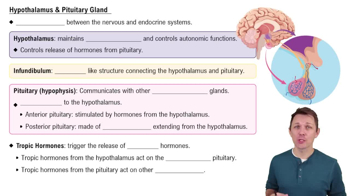
Role of the Hypothalamus and Pituitary Gland in Water Balance
Urine Specific Gravity and Its Clinical Significance
Explain how the chemical buffer systems resist changes in pH.
Explain how emphysema and congestive heart failure can lead to acid-base imbalance.
Explain the relationship of the following to renal secretion and excretion of hydrogen ions:
Plasma carbon dioxide levels
Phosphate
Sodium bicarbonate reabsorption
Mrs. Bush, a 70-year-old woman, is admitted to the hospital. Her history states that she has been suffering from diarrhea for three weeks. On admission, she complains of severe fatigue and muscle weakness. A blood chemistry study yields the following information: Na⁺ 142 mEq/L; K⁺ 1.5 mEq/L; Cl⁻ 92 mEq/L; Pco₂ 32 mm Hg.
Which electrolytes are within normal limits? Which are so abnormal that the patient has a medical emergency?
Which of the following represents the greatest danger to Mrs. Bush?
a. A fall due to her muscular weakness
b. Edema
c. Cardiac arrhythmia and cardiac arrest.
Describe the role of the respiratory system in controlling acid-base balance.