Ch. 25 The Urinary System
Hoehn - Marieb Human Anatomy & Physiology, 12th edition
Hoehn, Haynes, Abbott12th EditionMarieb Human Anatomy & PhysiologyISBN: 9780138242732Not the one you use?Change textbook
Chapter 25, Problem 14

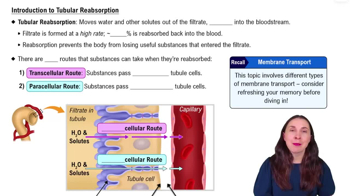
Describe what is involved in active and passive tubular reabsorption.

Verified step by step guidance
1
Step 1: Understand that tubular reabsorption is the process by which substances are moved from the filtrate in the renal tubules back into the blood in the peritubular capillaries, helping the body retain essential molecules and maintain homeostasis.
Step 2: Define passive tubular reabsorption as the movement of substances down their concentration or electrochemical gradients without the use of cellular energy (ATP). This typically involves diffusion or osmosis of molecules like water, urea, and some ions.
Step 3: Define active tubular reabsorption as the process that requires energy (usually ATP) to move substances against their concentration gradient. This involves specific transport proteins or pumps in the tubular cell membranes, such as the sodium-potassium pump.
Step 4: Explain that active reabsorption is crucial for reclaiming important solutes like glucose, amino acids, and ions (e.g., sodium, calcium), which are often moved via carrier-mediated transport mechanisms.
Step 5: Summarize that both active and passive reabsorption work together in different segments of the nephron to efficiently recover water and solutes, ensuring the body maintains fluid and electrolyte balance.

Verified video answer for a similar problem:

This video solution was recommended by our tutors as helpful for the problem above.
Video duration:
1m
Was this helpful?

Key Concepts

Here are the essential concepts you must grasp in order to answer the question correctly.

Active Tubular Reabsorption

Active tubular reabsorption is the process by which substances are transported from the renal tubule back into the blood using energy, typically ATP. This mechanism allows the kidney to selectively reclaim essential molecules like glucose, amino acids, and ions against their concentration gradients.
Recommended video:
4:06
Introduction to Tubular Reabsorption

Passive Tubular Reabsorption

Passive tubular reabsorption occurs without the use of cellular energy, relying on diffusion or osmosis to move substances down their concentration or electrochemical gradients. Water and some solutes like urea are commonly reabsorbed passively in the renal tubules.
Recommended video:
4:06
Introduction to Tubular Reabsorption

Renal Tubule Structure and Function

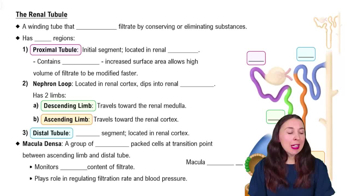
The renal tubule is a part of the nephron where filtrate is processed into urine. Its segments, including the proximal tubule, loop of Henle, distal tubule, and collecting duct, have specialized roles in reabsorbing water and solutes, which is essential for maintaining body fluid balance and homeostasis.
Recommended video:
4:21
The Renal Tubule