Ch. 24 Nutrition, Metabolism, and Energy Balance
Hoehn - Marieb Human Anatomy & Physiology, 12th edition
Hoehn, Haynes, Abbott12th EditionMarieb Human Anatomy & PhysiologyISBN: 9780138242732Not the one you use?Change textbook
Chapter 24, Problem 1

Which of the following reactions would liberate the most energy?
a. Complete oxidation of a molecule of sucrose to CO₂ and water
b. Conversion of a molecule of ADP to ATP
c. Respiration of a molecule of glucose to lactic acid
d. Conversion of a molecule of glucose to carbon dioxide and water

Verified step by step guidance
1
Step 1: Understand the concept of energy liberation in biochemical reactions. Energy is released during the breakdown of molecules, and the amount of energy depends on the completeness of the reaction and the type of molecule being metabolized.
Step 2: Analyze option (a): Complete oxidation of sucrose to CO₂ and water. Sucrose is a disaccharide composed of glucose and fructose. Complete oxidation involves breaking all bonds in the molecule, releasing a significant amount of energy as ATP and heat.
Step 3: Analyze option (b): Conversion of ADP to ATP. This process involves phosphorylation, which stores energy rather than liberating it. It is an energy-requiring process rather than an energy-liberating one.
Step 4: Analyze option (c): Respiration of glucose to lactic acid. This is anaerobic respiration, which is less efficient and releases less energy compared to complete oxidation. Only a small amount of ATP is generated in this process.
Step 5: Analyze option (d): Conversion of glucose to CO₂ and water. This is aerobic respiration, which involves complete oxidation of glucose. It releases a large amount of energy, similar to option (a), but glucose is a simpler molecule compared to sucrose, so the energy liberated is slightly less than in option (a).

Verified video answer for a similar problem:

This video solution was recommended by our tutors as helpful for the problem above.
Video duration:
2m
Was this helpful?

Key Concepts

Here are the essential concepts you must grasp in order to answer the question correctly.

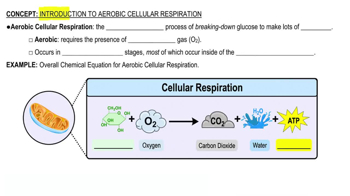
Cellular Respiration

Cellular respiration is a metabolic process that converts biochemical energy from nutrients into adenosine triphosphate (ATP), and releases waste products. It typically involves the complete oxidation of glucose or other substrates, resulting in the production of carbon dioxide and water, and is crucial for energy production in living organisms.
Recommended video:
03:38
Introduction to Cellular Respiration

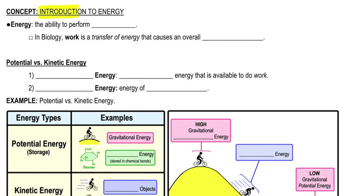
Energy Yield of Reactions

Different biochemical reactions yield varying amounts of energy. For instance, the complete oxidation of glucose releases significantly more energy compared to the conversion of ADP to ATP, which is a relatively low-energy process. Understanding the energy yield helps in comparing the efficiency of different metabolic pathways.
Recommended video:
4:58
Introduction to Energy

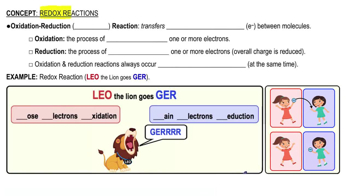
Oxidation-Reduction Reactions

Oxidation-reduction (redox) reactions are chemical reactions that involve the transfer of electrons between two substances. In the context of cellular respiration, the oxidation of glucose involves the loss of electrons, which are transferred to oxygen, ultimately leading to the production of energy. This concept is essential for understanding how energy is liberated during metabolic processes.
Recommended video:
04:46
Redox Reactions