Ch. 24 Nutrition, Metabolism, and Energy Balance
Hoehn - Marieb Human Anatomy & Physiology, 12th edition
Hoehn, Haynes, Abbott12th EditionMarieb Human Anatomy & PhysiologyISBN: 9780138242732Not the one you use?Change textbook
Chapter 24, Problem 7

In a temperate climate under ordinary conditions, the greatest loss of body heat occurs through:
a. Radiation
b. Conduction
c. Evaporation
d. None of the above

Verified step by step guidance
1
Understand the mechanisms of heat loss in the human body: Radiation, conduction, evaporation, and convection are the primary ways the body loses heat. Radiation involves the emission of infrared heat waves from the body to the surrounding environment, conduction is the transfer of heat through direct contact, and evaporation occurs when sweat or moisture on the skin turns into vapor, carrying heat away.
Consider the environmental conditions described in the problem: A temperate climate under ordinary conditions typically means moderate temperatures and humidity levels, without extreme heat or cold.
Analyze the role of radiation in heat loss: Radiation is the primary method of heat loss in most conditions, as the body constantly emits heat to cooler surroundings, especially when the air temperature is lower than body temperature.
Evaluate conduction and evaporation: Conduction is less significant unless the body is in direct contact with a cooler surface. Evaporation becomes more prominent in hot or humid conditions when sweating increases, but under ordinary temperate conditions, it is not the dominant method of heat loss.
Conclude based on the physiological principles: Radiation is generally the greatest contributor to heat loss in temperate climates under ordinary conditions, as it does not rely on external factors like direct contact or excessive sweating.

Verified video answer for a similar problem:

This video solution was recommended by our tutors as helpful for the problem above.
Video duration:
2m
Was this helpful?

Key Concepts

Here are the essential concepts you must grasp in order to answer the question correctly.

Radiation

Radiation is the process by which heat is transferred from one object to another through electromagnetic waves. In a temperate climate, the body loses heat primarily through radiation, as it emits infrared radiation to the cooler surrounding environment. This form of heat loss does not require direct contact with another object, making it a significant factor in thermoregulation.
Recommended video:
Guided course
3:08
Introduction to Special Senses Example 1

Conduction

Conduction is the transfer of heat through direct contact between materials. In the context of body heat loss, conduction occurs when the skin comes into contact with cooler surfaces, such as cold air or objects. While it contributes to heat loss, its impact is generally less significant than radiation in a temperate climate.
Recommended video:
Guided course
7:14
Conduction Pathway and Contraction

Evaporation

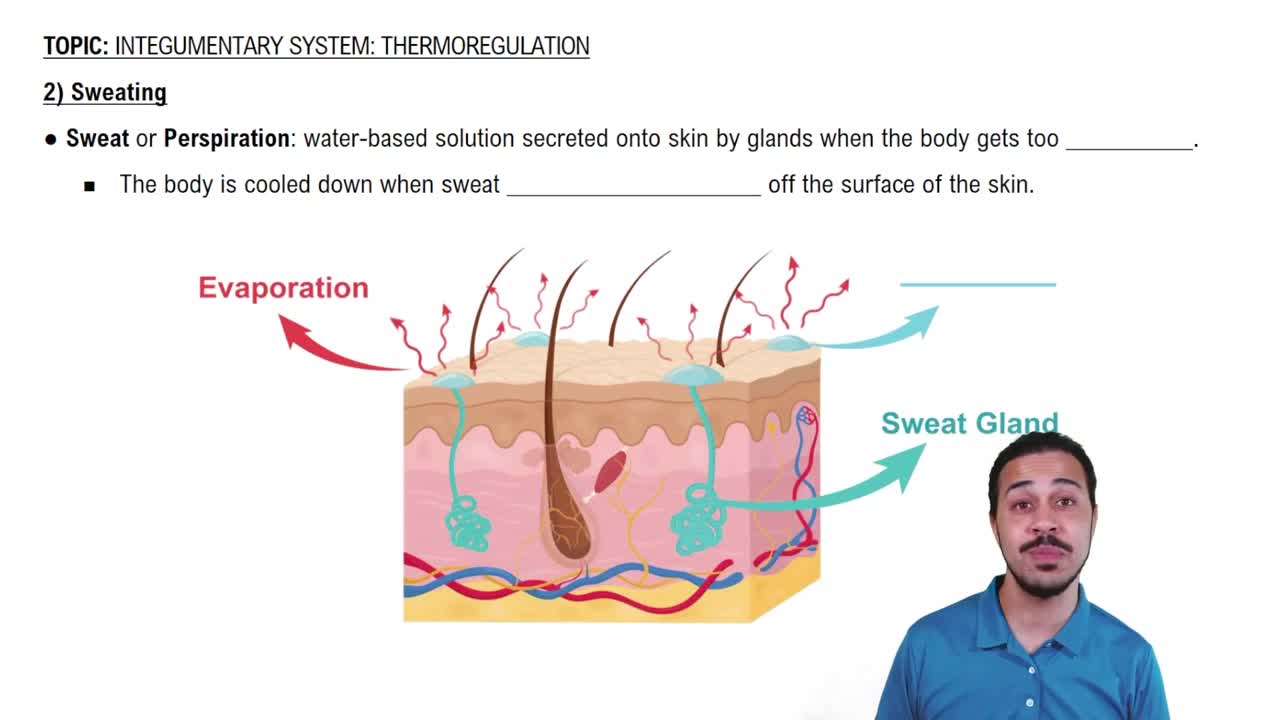
Evaporation is the process by which liquid water is converted into vapor, resulting in heat loss from the body. This occurs primarily through sweating, where moisture on the skin evaporates, cooling the body. Although important in hot conditions, in a temperate climate, radiation typically accounts for greater heat loss under ordinary conditions.
Recommended video:
01:22
Sweating