
Ch. 23 The Digestive System
Hoehn - Marieb Human Anatomy & Physiology, 12th edition
Hoehn, Haynes, Abbott12th EditionMarieb Human Anatomy & PhysiologyISBN: 9780138242732Not the one you use?Change textbook
Chapter 23, Problem 27

Explain why activation of pancreatic enzymes is delayed until they reach the small intestine.

Verified step by step guidance
1
Understand that pancreatic enzymes are initially secreted in an inactive form called zymogens to prevent them from digesting proteins within the pancreas itself, which could cause tissue damage.
Recognize that these inactive enzymes require activation in the small intestine to become functional and start the digestion process safely.
Identify that the small intestine produces an enzyme called enterokinase (or enteropeptidase), which specifically activates the pancreatic zymogen trypsinogen into trypsin.
Know that trypsin then activates other pancreatic enzymes by converting their inactive forms into active enzymes, ensuring digestion occurs only in the small intestine.
Conclude that this delayed activation mechanism protects the pancreas from autodigestion and ensures enzymes act only where food digestion is needed.

Verified video answer for a similar problem:

This video solution was recommended by our tutors as helpful for the problem above.
Video duration:
2m
Was this helpful?

Key Concepts

Here are the essential concepts you must grasp in order to answer the question correctly.

Pancreatic Enzymes and Their Function

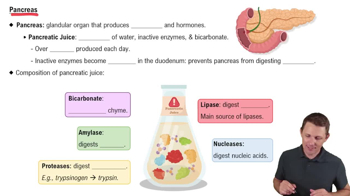
Pancreatic enzymes are digestive proteins produced by the pancreas that break down carbohydrates, proteins, and fats. They are initially secreted in inactive forms called zymogens to prevent self-digestion of the pancreas and surrounding tissues.
Recommended video:
02:32
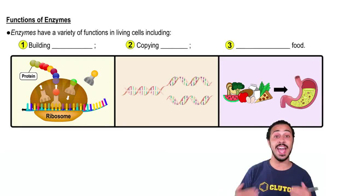
Functions of Enzymes

Zymogen Activation Mechanism

Zymogens are inactive enzyme precursors that require specific biochemical changes to become active. In the small intestine, enzymes like enterokinase convert trypsinogen into trypsin, which then activates other pancreatic enzymes, ensuring digestion occurs only in the intestine.
Recommended video:
02:37
Active Transport

Protection of Pancreatic Tissue

Delaying enzyme activation until reaching the small intestine protects the pancreas from autodigestion and inflammation. If enzymes were activated prematurely within the pancreas, they would digest pancreatic tissue, leading to pancreatitis and tissue damage.
Recommended video:
Related Practice
Textbook Question

Troy Francis, a middle-aged salesman, complains of a burning pain in the 'pit of his stomach,' usually beginning about two hours after eating and abating after drinking a glass of milk. When asked to indicate the site, he points to his epigastric region. The GI tract is examined by X-ray fluoroscopy. A gastric ulcer is visualized, and drug therapy using a proton pump inhibitor and antibiotics is recommended.

a. Why is this treatment suggested?

b. What are the possible consequences of nontreatment?

1
views
Textbook Question

After a heavy meal rich with fried foods, Debby Collins, an overweight 45-year-old woman, was rushed to the emergency room with severe spasmodic pains in her epigastric region that radiated to the right side of her rib cage. She indicated that the attack came on suddenly, and her abdomen was found to be tender to the touch and somewhat rigid. What do you think is this patient's problem and why is her pain discontinuous (colicky)? What are the treatment options and what might happen if the problem is not resolved?

2
views
Textbook Question

A baby is admitted to the hospital with a history of diarrhea and watery feces occurring over the last three days. The baby has sunken fontanelles (the not yet ossified spaces between skull bones in infants), indicating extreme dehydration. Tests indicate that the baby has a bacterium-induced colitis, and antibiotics are prescribed. Because of the baby's loss of intestinal juices, do you think that his blood pH would indicate acidosis or alkalosis? Explain your reasoning.

Textbook Question

a. What is the relationship between the cystic, common hepatic, bile, and pancreatic ducts?

b. What is the point of fusion of the bile and pancreatic ducts called?

2
views
Textbook Question

Indicate the function of the stellate macrophages and the hepatocytes of the liver.

5
views
Textbook Question

Explain why fatty stools result from the absence of bile or pancreatic juice.

1
views