Ch. 21 The Immune System: Innate and Adaptive Body Defenses
Hoehn - Marieb Human Anatomy & Physiology, 12th edition
Hoehn, Haynes, Abbott12th EditionMarieb Human Anatomy & PhysiologyISBN: 9780138242732Not the one you use?Change textbook
Chapter 21, Problem 22

What accounts for the declining efficiency of the immune system with age?

Verified step by step guidance
1
Understand that the immune system's efficiency declines with age due to multiple physiological changes, often referred to as immunosenescence.
Identify that one major factor is the reduced production of new immune cells, especially T cells, because the thymus gland shrinks and becomes less active over time.
Recognize that aging also leads to a decreased function of existing immune cells, including diminished ability of T cells and B cells to respond to new antigens effectively.
Consider that the accumulation of memory cells from past infections can crowd out the space for naive cells, limiting the immune system's ability to respond to novel pathogens.
Acknowledge that chronic low-grade inflammation, often called 'inflammaging,' can impair immune responses and contribute to the overall decline in immune efficiency with age.

Key Concepts

Here are the essential concepts you must grasp in order to answer the question correctly.

Immunosenescence

Immunosenescence refers to the gradual deterioration of the immune system associated with aging. It involves reduced production and function of immune cells, leading to weaker responses to infections and vaccines. This decline affects both innate and adaptive immunity, making older adults more susceptible to diseases.

Thymic Involution

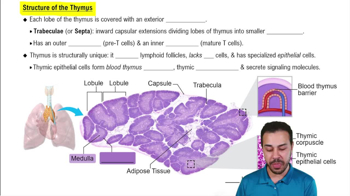
Thymic involution is the process by which the thymus gland shrinks and loses function with age. Since the thymus is responsible for producing naive T cells, its decline reduces the generation of new T cells, limiting the immune system's ability to respond to new antigens and contributing to decreased immune efficiency.
Recommended video:
8:23
Structure of the Thymus

Chronic Inflammation (Inflammaging)

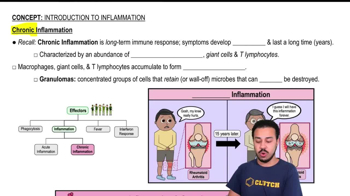
Chronic low-grade inflammation, or inflammaging, is a persistent, systemic inflammatory state that develops with age. It can impair immune function by exhausting immune cells and promoting tissue damage, thereby reducing the immune system's ability to fight infections and increasing the risk of age-related diseases.
Recommended video:
3:09
Chronic Inflammation